

Somewhere in a cave deposit at Zhoukoudian, China, a researcher named Wenzhong Pei found twenty quartz crystals in 1931. They were sitting alongside the bones of Homo erectus, in sediment dated to at least 600,000 years ago, and possibly older than 800,000. None of the crystals had been shaped into tools. None were perforated for wearing. They hadn’t been used on anything — no use-wear, no modification, no sign that anyone tried to do something practical with them. They were just there, carried in from somewhere else and kept.
This keeps happening. Six quartz prisms at a Lower Acheulian site in India, between 150,000 and 300,000 years old. A fragment of transparent rock crystal in an Acheulian layer in Austria. Quartz crystals in strata at Wonderwerk Cave in South Africa, dated between 276,000 and 500,000 years before the present. And more recently, calcite crystals collected by early Homo sapiens in the Kalahari around 105,000 years ago — crystals that, again, were not used as ornaments or tools.
All of them euhedral. All of them well-formed, with clear crystal faces. All of them transported from their geological source to wherever hominins were sleeping.
The question nobody has had a good answer to is why.
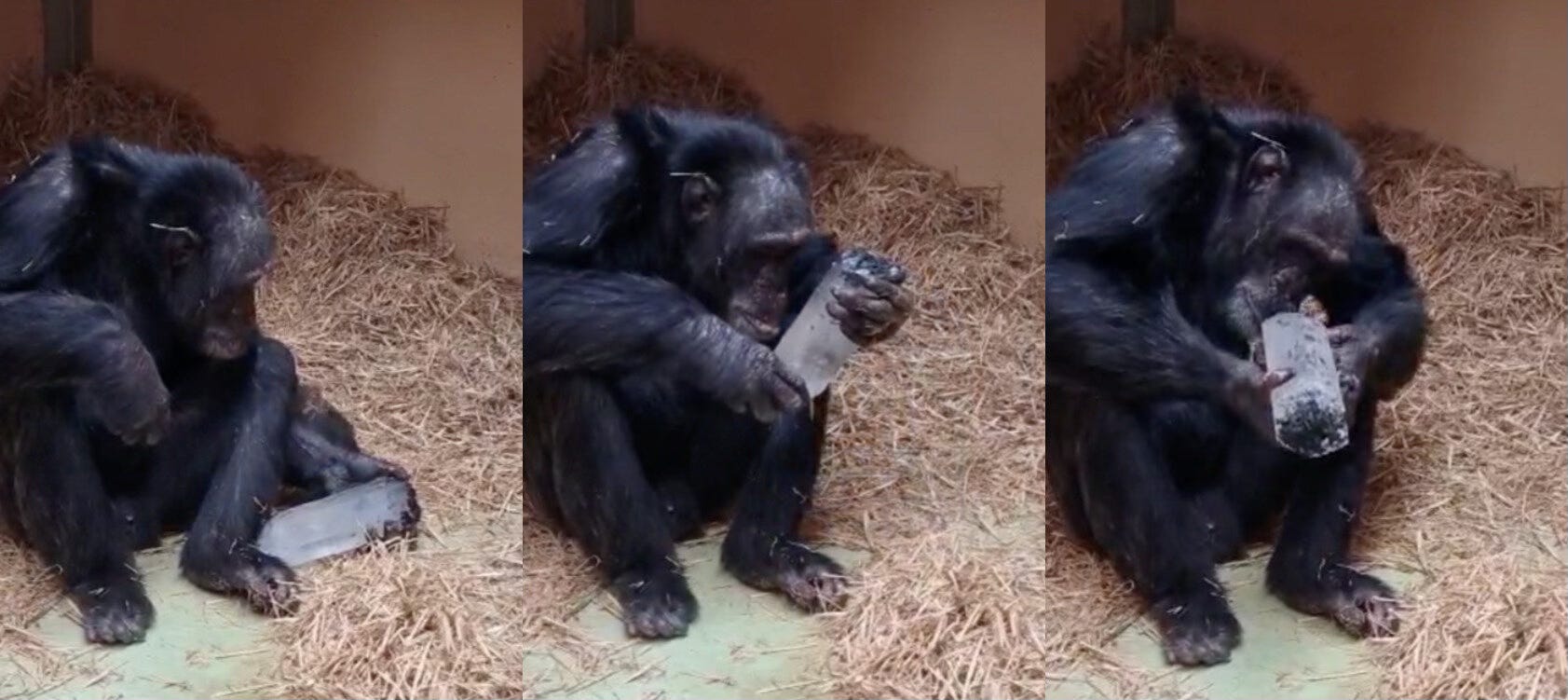
A team of researchers led by Juan Manuel García-Ruiz at the Donostia International Physics Center in Spain recently published an attempt to get at this question from a different angle. Since you can’t run experiments with H. erectus, they ran them with Pan troglodytes — chimpanzees, our closest living relatives, from whom we diverged roughly six to seven million years ago. Their paper, published in Frontiers in Psychology1 in early 2026, describes what happened when they gave two groups of enculturated chimps access to crystals and watched carefully. What they found is genuinely strange…
Toti analyzing the shape of the crystal. Credit: Frontiers in Psychology (2026). DOI: 10.3389/fpsyg.2026.1633599


