

Watch two Pan troglodytes playing. Their mouths open wide, lips stretched back, sometimes showing the lower teeth, sometimes the upper row too. Now watch one of them mirror the other. Not just any open-mouth face — the same one. If one ape plays with upper teeth hidden, the other hides its upper teeth too. The match happens fast, often within a second, sometimes within three.
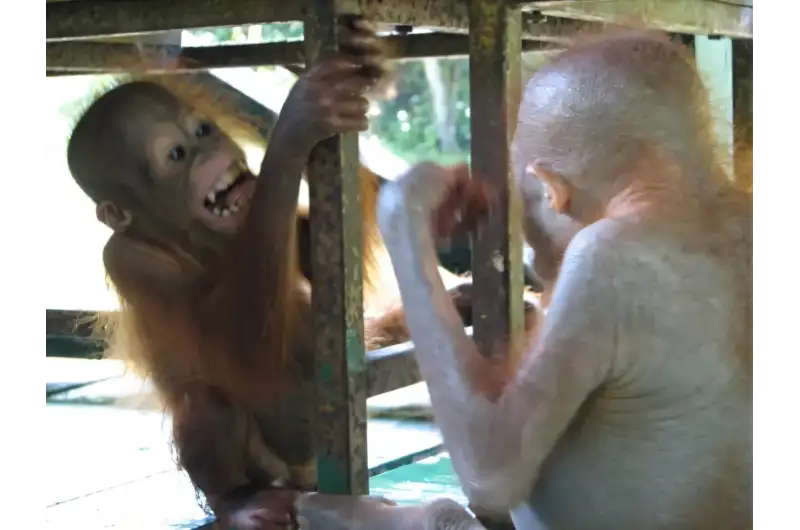
That specificity is what a new study1 from the University of Portsmouth set out to document. The question wasn’t simply whether great apes mirror each other’s facial expressions during play. That much was already known. The question was whether they do it exactly — matching the specific variant their partner used, the way a human spontaneously mirrors a Duchenne smile.
The answer, from a sample of 96 apes across two species and eight social groups, appears to be yes.
Diane Austry, lead author and now based at Durham University, along with a team including Marina Davila-Ross and Guillaume Dezecache, studied 39 Pongo pygmaeus at the Sepilok Orangutan Rehabilitation Centre in Malaysia and 57 Pan troglodytes at the Chimfunshi Wildlife Orphanage in Zambia. The animals were video-recorded during spontaneous social play, and their laugh faces — technically, open-mouth faces, or OMFs — were coded frame by frame at 25 frames per second. Each open-mouth expression was classified as either showing the upper teeth or not. Then the researchers looked at whether the observing animal matched the specific variant its partner had just produced, within three seconds of that production.
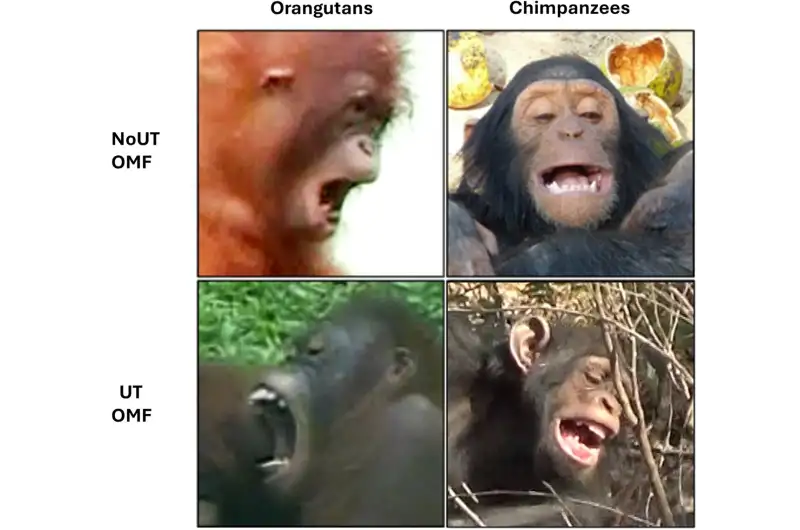
That three-second window matters. It spans both the rapid automatic response seen in less than a second, which is measured in facial mimicry research more broadly, and the slower delayed response. The average latency in this study was just over a second for both species: around 1.1 seconds mean, with more than half of all responses landing under one second.


