

Sometime in the early 1970s, a researcher at Gombe noticed that chimpanzees in one community fished for termites with grass tools in a way that differed, consistently, from how chimpanzees elsewhere did the same job. The behavior was too widespread within the group and too stable across time to be individual improvisation. It looked, in other words, like culture. This was not supposed to be possible — or at least, it was not supposed to require that word.
What followed was not a clean scientific resolution. It was a war.
The term “ape culture wars” was coined by primatologist William McGrew in 2003, but the conflict it names has older roots. In its early form, the question was binary: do non-human great apes have culture or not? Field researchers — biologists and primatologists who spent their careers watching chimpanzees in Gombe, Taï, Mahale, and Bossou — tended to say yes. Psychologists running experiments with captive apes in laboratories tended to be more skeptical, or at least more demanding in what they’d accept as evidence. Two research communities, two methodological traditions, and a fundamental disagreement about what counted as proof.
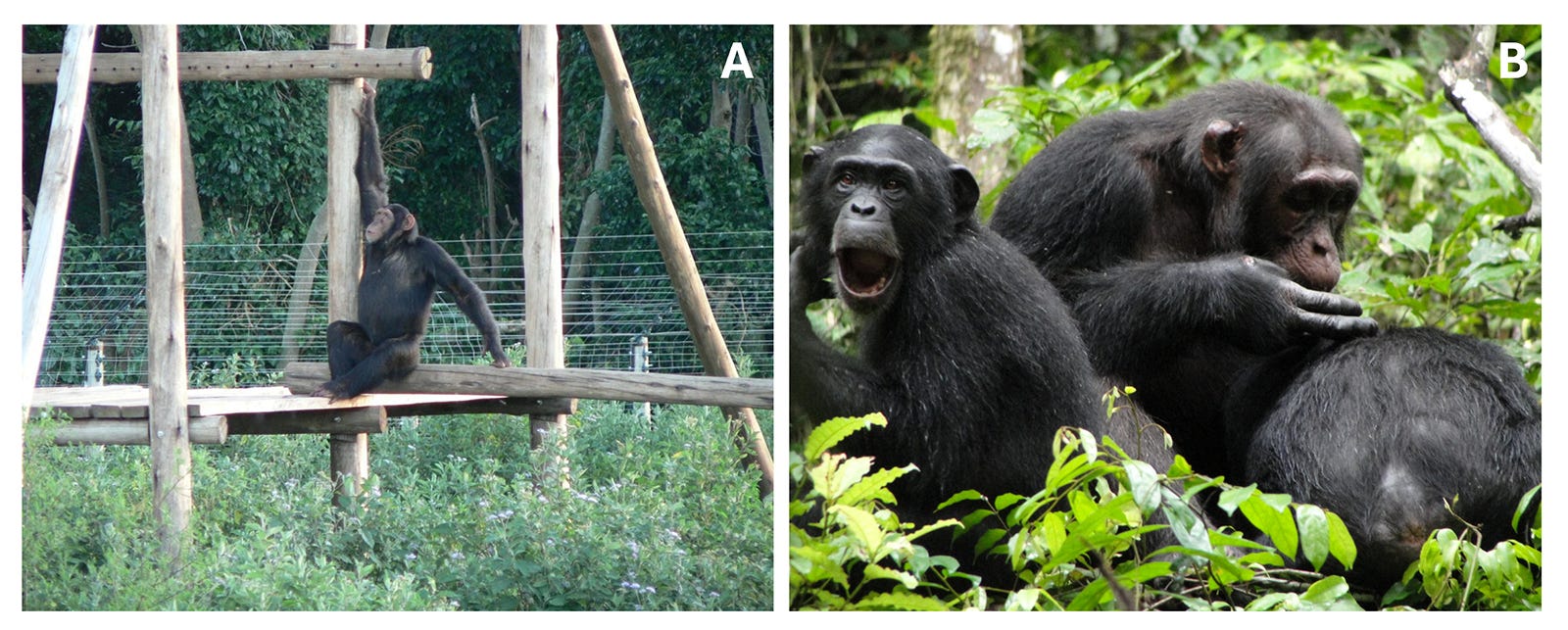
That version of the war is largely over. The evidence for cross-population behavioral differences in Pan troglodytes — differences that can’t be explained by genetics or ecology alone — has accumulated to the point where most researchers across both camps now accept that great apes have cultures of some kind. The same has been documented in Pongospecies, in bonobos, and to a lesser extent in gorillas. Indirect evidence for social learning, the mechanism typically taken as culture’s precondition, is also documented in capuchins, macaques, cetaceans, birds, and apparently even bumblebees.
The question “do apes have culture” has been replaced by a thornier set of questions: what kind of culture, transmitted through which mechanisms, producing which kinds of products? This is where the current war is being fought, and in a 2026 paper in Evolutionary Human Sciences,1 primatologists Ammie Kalan and Claudio Tennie attempt something unusual — a diagnosis from both sides simultaneously. Kalan works primarily with wild apes; Tennie primarily with captive ones. Their paper is part historiography, part peace treaty, and part metacritique of a field they argue has allowed genuine scientific divisions to calcify into something more tribal.


