
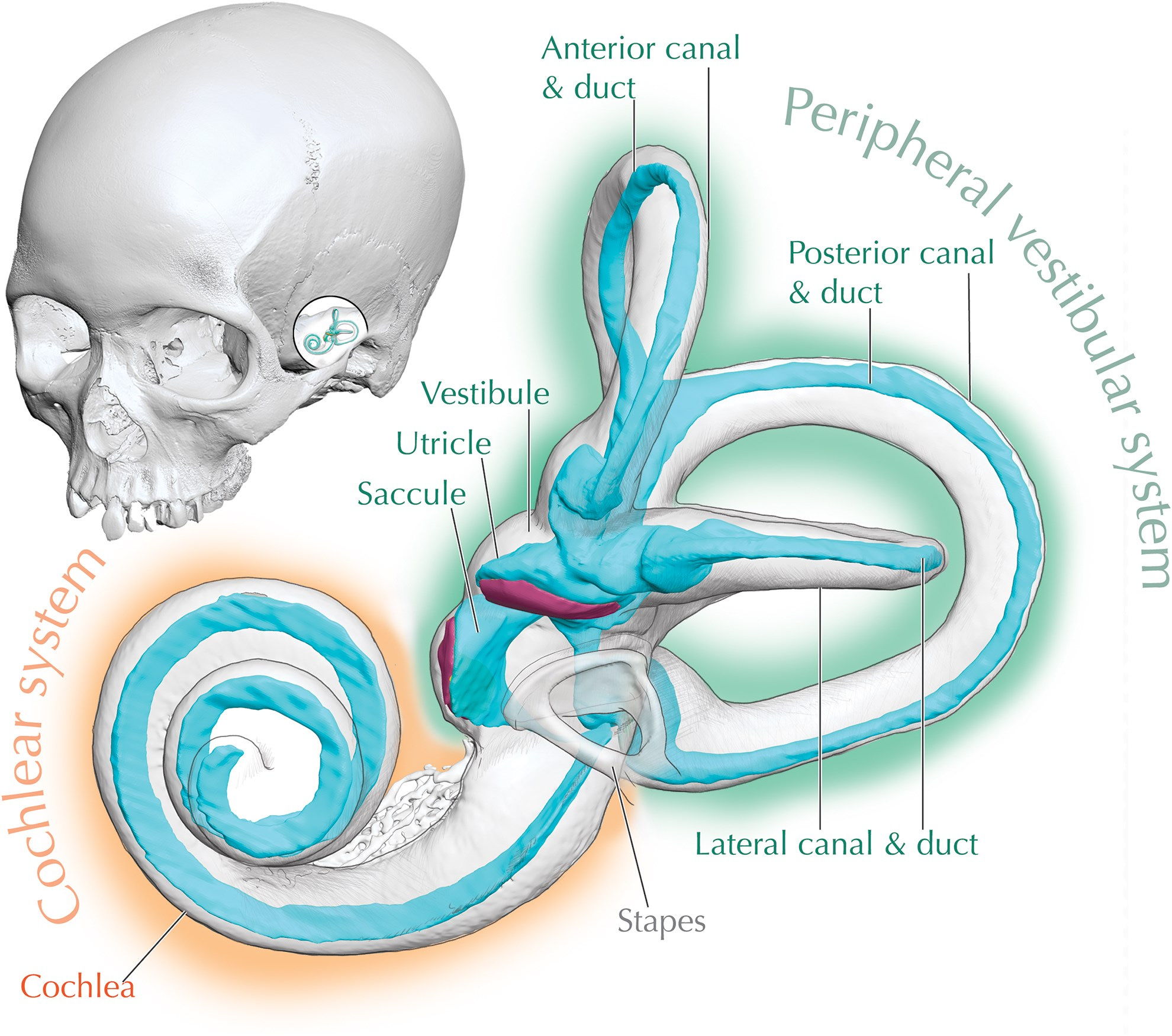
We have been taught for a long time that the inner ear is a two-room suite. One room, the cochlea, is for hearing. The other, the vestibular system, is for balance. This binary model is the bedrock of how we understand everything from human evolution to inner ear disorders. It is simple. It is intuitive. It is also, according to a new study, incomplete.
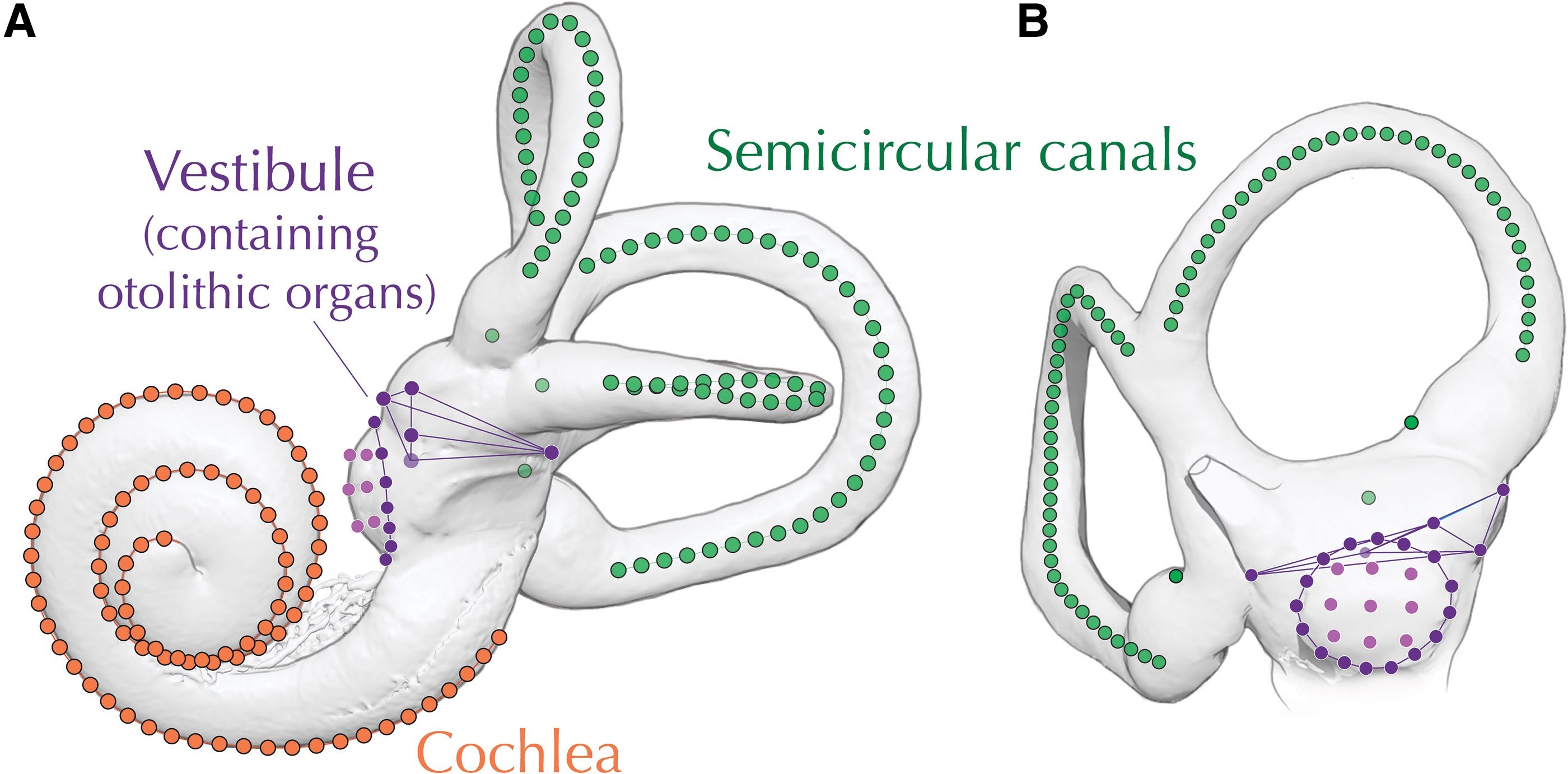
A team led by Christopher M. Smith and Jeffrey T. Laitman recently analyzed1 the inner ears of 14 primate species, including the agile gibbon and the upright Homo sapiens. They used 3D imaging to map the delicate landmarks of the bony labyrinth, the hard shell that houses our sensory organs. Their goal was to see if the balance half of the ear is actually a single unit or if it is made of independent parts.
The team found that the vestibular system is not a monolith. It is modular.
A Third Room in the Labyrinth
In the traditional view, the semicircular canals and the otolithic organs are grouped together as one peripheral vestibular system. The canals are the gyroscopes that detect rotation, while the otolithic organs, the utricle and saccule, detect linear movement and the constant pull of gravity. We have often assumed that these parts evolve in lockstep. If an animal develops larger canals to handle acrobatic movement, we assumed the rest of the vestibular system grew with them.
Smith and his colleagues found that this integration is a myth. Their statistical analysis of species like Pan troglodytesand Gorilla gorilla showed that the canals and the otoliths are semi-independent modules. They follow different evolutionary trajectories and respond to different selective pressures. The researchers propose a tripartite model instead: a cochlear system for hearing, a canalicular system for rotation, and an otolithic system for gravity.
This shift in perspective is more than an academic reclassification. It reveals that our balance system has a hidden flexibility. The different parts of the ear are evolvable on their own. This modularity allows a species to fine-tune its sense of gravity without necessarily changing how it senses a head turn.
The Independent Evolution of Gravity
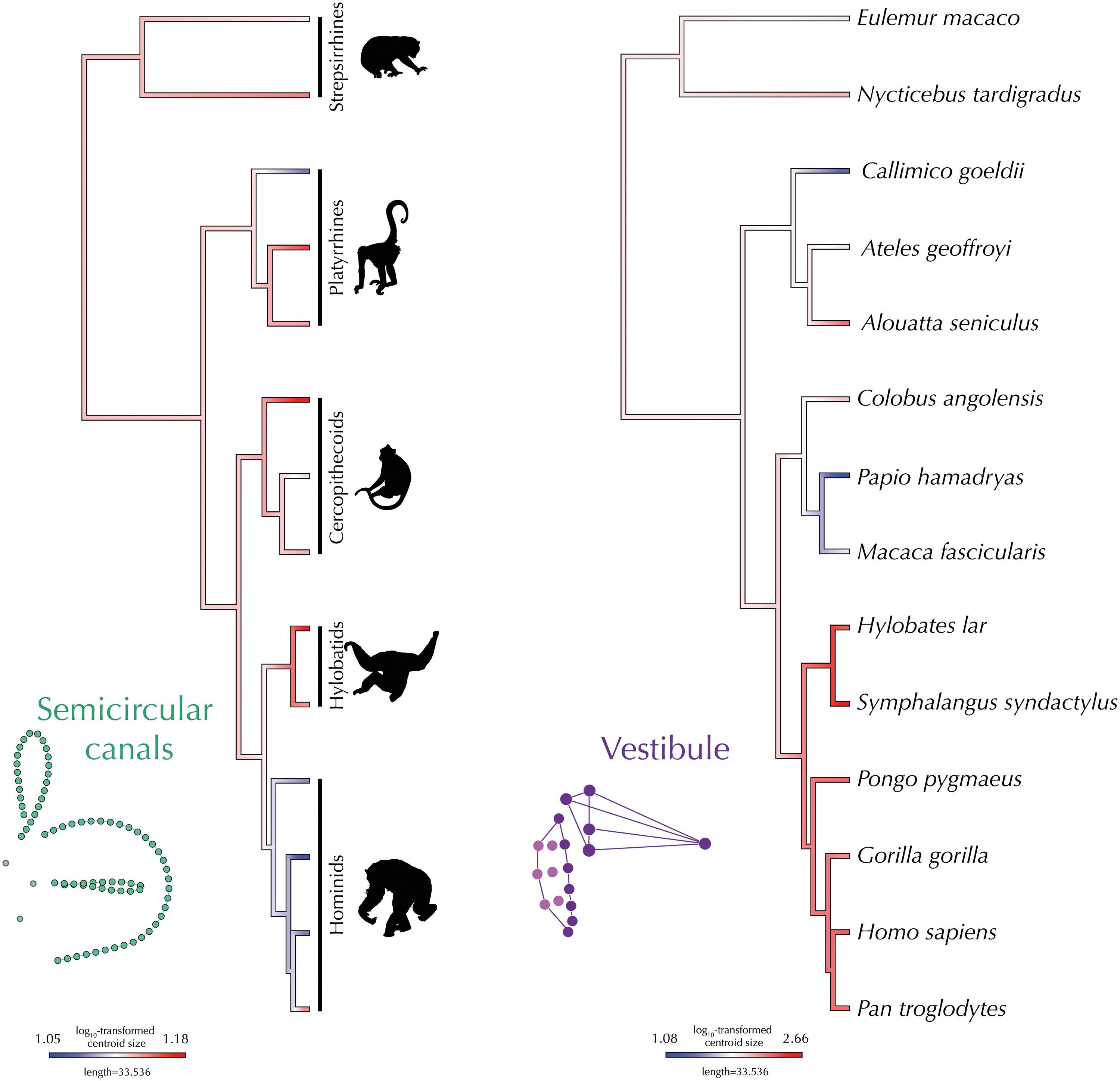
The evidence for this decoupling is clearest when looking at our own lineage. Across the great apes, the otolithic system has undergone a large-scale increase in relative size. In the past, researchers noticed that catarrhine primates had enlarged vestibules, but they often dismissed this as a byproduct of semicircular canal enlargement.
This study suggests the opposite. The expansion of the vestibule in hominoids is an independent evolutionary event. It may be linked to the complex ways apes move through three-dimensional space, where sensing the orientation of the body relative to gravity is just as critical as sensing the speed of a swing.
There is also a deep history here that reaches back to the water. The otolithic organs in mammals still carry a shadow of their original function in fish as vibration detectors. Modern mammals can actually hear certain bone-conducted or airborne sounds through their otoliths. By treating these organs as a distinct system, we begin to see the ear not just as a balance sensor, but as an ancient, multi-purpose tool for navigating a physical world.
This tripartite model changes how we read fossils. When we find the petrous bone of an ancient primate, we can no longer look at one part of the vestibular system and assume it tells the whole story of how that animal moved. The canals might tell us about its agility, but the otoliths tell a separate story about its relationship with gravity. We are looking at two different evolutionary clocks ticking inside the same small bone.
Smith, C.M., et al. (2026). Evolutionary modularity of the primate vestibular system: Morphological distinction of otolithic and canalicular organs. PNAS Nexus.


