

Some of the apes at Leipzig Zoo have been enrolled in cognitive experiments for nearly two decades. Not continuously — participation is always voluntary — but repeatedly, study after study, across a research career that spans a chimpanzee’s middle age. One individual appears in 122 published studies. The average, across all 81 apes in the dataset, is nearly 40.
That single fact reveals the central problem in great ape cognition research. These are the animals closest to us in evolutionary time. Pan troglodytes and Pan paniscus diverged from our lineage roughly six million years ago. But they are rare, protected, and impossible to study at the population scales that psychology and anthropology usually demand. A typical cognitive experiment might involve six individuals. Results get published. Then another team runs another study at a different institution, with a slightly different method, and finds something that contradicts the first finding, or qualifies it, or fails to replicate it. Over decades, the literature accumulates without quite cohering.
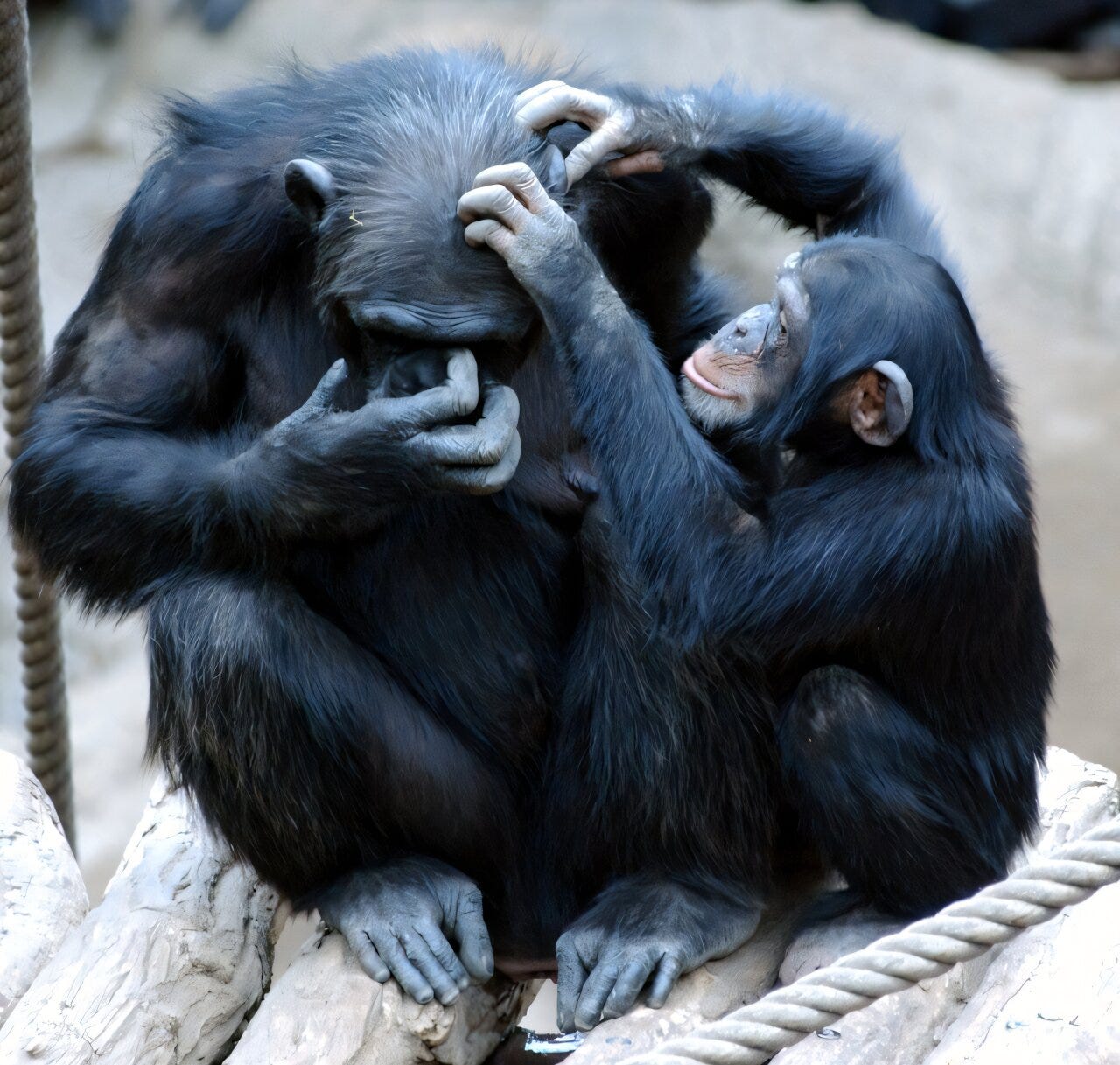
The EVApeCognition Dataset, published this spring in Scientific Data,1 is an attempt to pull that accumulated evidence together. A team led by Alejandro Sánchez-Amaro at the University of Stirling and Daniel Haun at the Max Planck Institute for Evolutionary Anthropology spent years contacting researchers, recovering raw data from archived server folders and old correspondence, standardizing everything into a common format, and releasing it publicly. The result is 262 experimental datasets drawn from 150 publications, spanning 18 years of research at the Wolfgang Köhler Primate Research Center in Leipzig.
The cognitive domains covered are wide. Studies on theory of mind, whether apes can represent what another individual knows or believes, sit alongside experiments on causal reasoning, long-term memory, cooperation, metacognition, tool use, and spatial representation. Social cognition and physical cognition each account for roughly half the dataset. Within social cognition, the largest single category is competition and cooperation, followed by theory of mind and metacognition. Within physical cognition, tools and causality predominate.


