

Start with two small bones. The lunate and the triquetrum sit in the inner wrist, wedged between the radius and the palm, and in a gorilla they look nearly identical to the same bones in a human. Not similar in a loose, family-resemblance way. Similar enough that machine learning algorithms, trained to distinguish kinematically distinct primate groups, consistently struggle to separate them.
That’s strange. Gorilla and Homo sapiens diverged from a common ancestor somewhere between eight and ten million years ago, and in that time we have done radically different things with our hands. Gorillas press the dorsal surfaces of their middle finger bones into the ground and walk on them. Humans flake stone, tie knots, and suture wounds. The behavioral gap is enormous. The carpal morphology, in those two bones at least, is not.
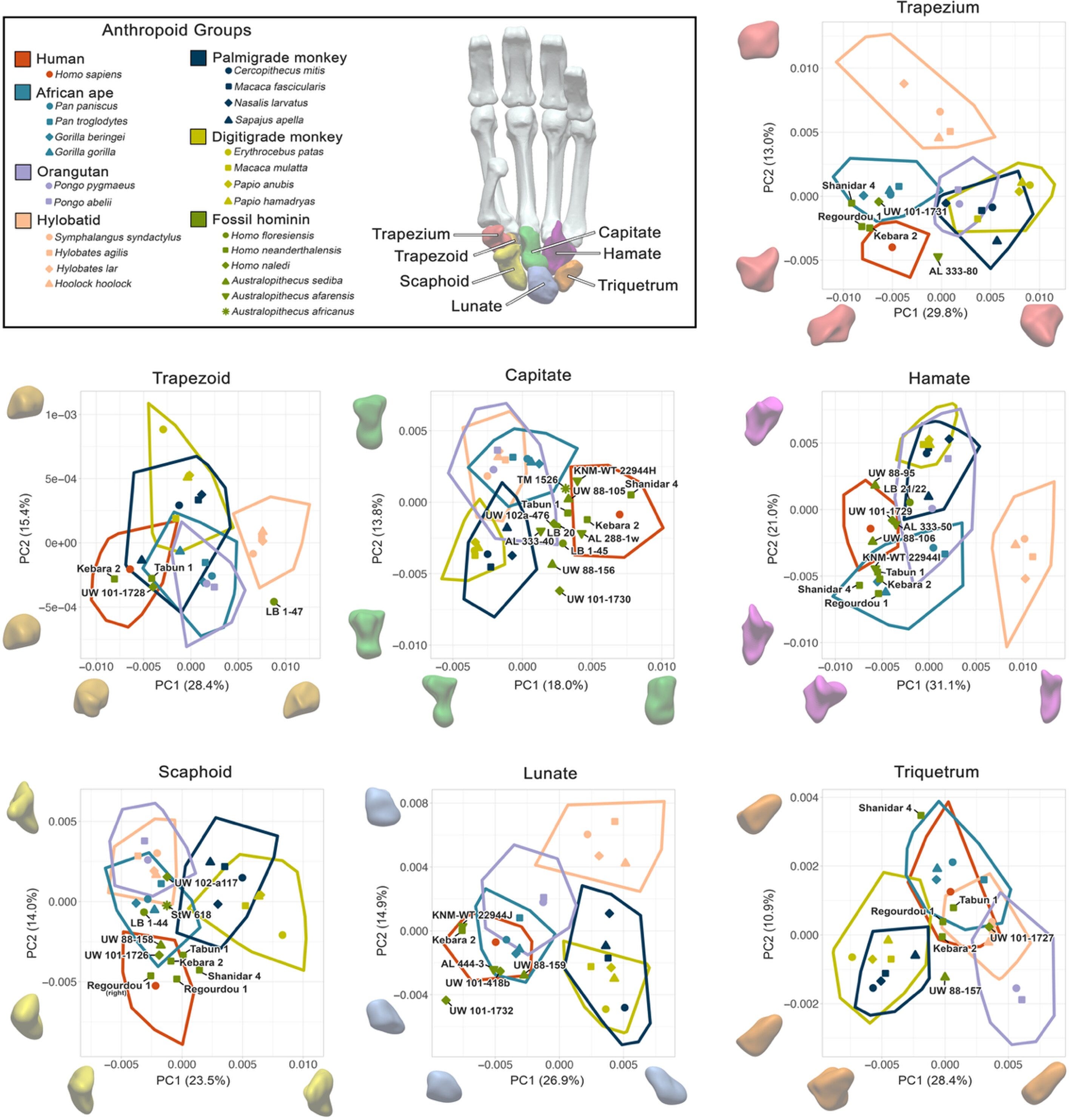
A new study published in Proceedings of the Royal Society B1 takes this observation and scales it up. Led by Laura Hunter at the University of Chicago, with co-authors Matthew Tocheri, Caley Orr, Biren Patel, and Zeresenay Alemseged, the analysis covers more than two thousand specimens from living primates and 55 fossil hominin carpals, using a mathematical approach called spherical harmonics to capture the three-dimensional geometry of each bone in full. Three machine learning methods then classified fossil wrist bones against the extant comparative sample. The result is the most comprehensive quantitative treatment of carpal morphology across anthropoids yet attempted, and it produces a finding that cuts against a popular alternative to the knuckle-walking ancestor hypothesis: the modern human wrist didn’t escape its African ape past. It grew out of it.


