

In August 2023, a chimpanzee named Juma picked up a blade of grass and stuck it in his ear. Not like he was scratching something. He pushed it deep enough that it stayed on its own, and then he went about his day with vegetation dangling from his ear canal.
Within a week, four other chimpanzees in his group were doing the same thing.
Eleven days later, Juma escalated. He inserted a blade of grass into his rectum and left it hanging. By the end of the month, five individuals at the Chimfunshi Wildlife Orphanage Trust in Zambia were walking around with grass protruding from various orifices. None of them showed any signs of discomfort. No red skin, no diarrhea, no scratching. Veterinary staff observed nothing that would suggest the grass was addressing any physical complaint.
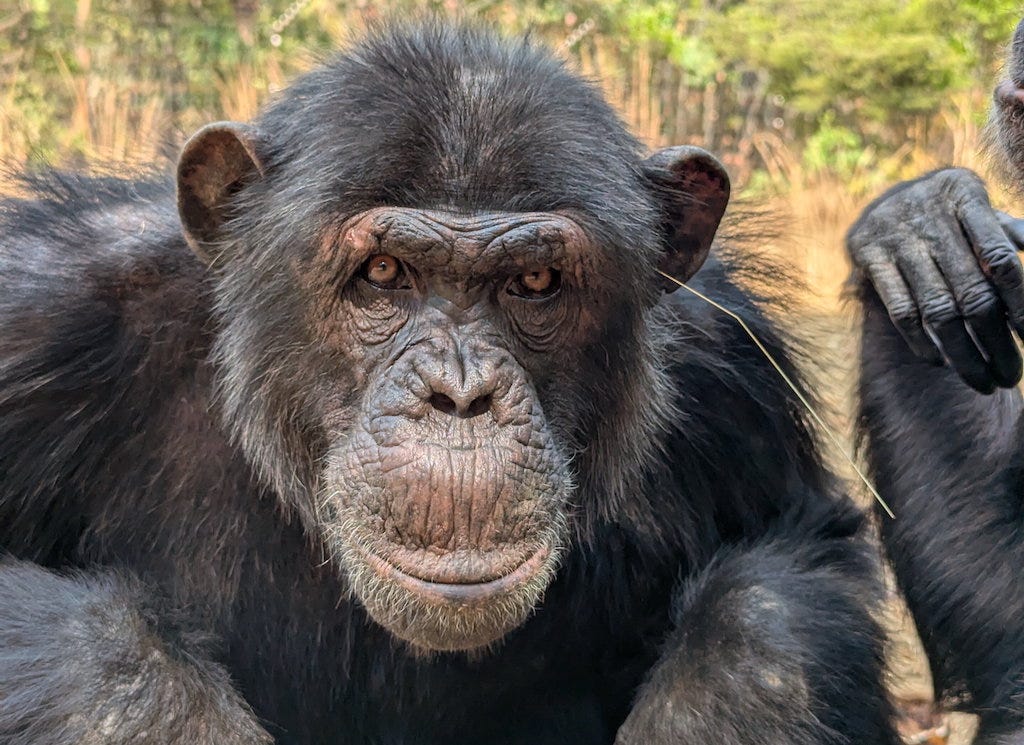
This is, on its face, absurd. But the absurdity is precisely what makes it worth taking seriously.
The researchers who documented this,1 led by Edwin van Leeuwen at Utrecht University, had 136 other chimpanzees across seven other social groups at the same sanctuary to compare against. Over about 1,100 hours of observation between May 2023 and October 2024, not one of those 136 individuals was seen doing anything like it. The grass-in-ear and grass-in-rectum behaviors were confined entirely to a single group of eight animals. The team ran network-based diffusion analyses, a statistical method that tests whether the order in which individuals pick up a behavior matches the social connections between them, and found 99% support for social transmission in both cases. The probability that these behaviors spread through independent individual discovery rather than copying was, effectively, negligible.
So. Chimpanzees (Pan troglodytes) copied a pointless behavior from each other. That is the finding. And it raises a question that, once you sit with it, gets genuinely strange: why would an animal copy something that does nothing?


