

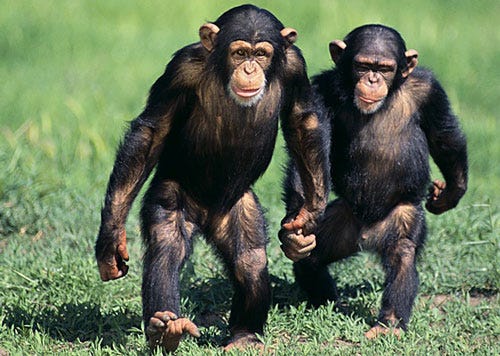
Fifteen Pan troglodytes at the Wolfgang Köhler Primate Research Centre in Leipzig were given sticks and a pool of yogurt. The sticks held up a transparent lid over the pool. Pull a stick out, use it to eat. But if all the sticks were removed, the lid fell shut — the yogurt was gone, and the trial was over. No stick-sharing, no turn-taking protocol, no rules. Just chimpanzees and an apparatus designed to reproduce one of the oldest problems in collective behavior: the tragedy of the commons.
The setup is elegant in its simplicity. Each individual has an incentive to extract as much as possible. But if everyone does that at once, the resource collapses and everyone loses. Garrett Hardin’s famous 1968 formulation framed this as a structural inevitability, though researchers since Elinor Ostrom have documented in detail how humans develop norms, rules, and communication strategies to sidestep it. What no one had tested, until now, was how chimpanzees perform at this problem when grouped in more than pairs.
The answer, published in Communications Psychology1 by Kirsten Sutherland, Daniel Haun, and Alejandro Sánchez-Amaro, is surprising in two respects. First: chimpanzee quartets significantly outperformed dyads at keeping the resource open. Second: the mechanism behind that success was not what the researchers expected.


