

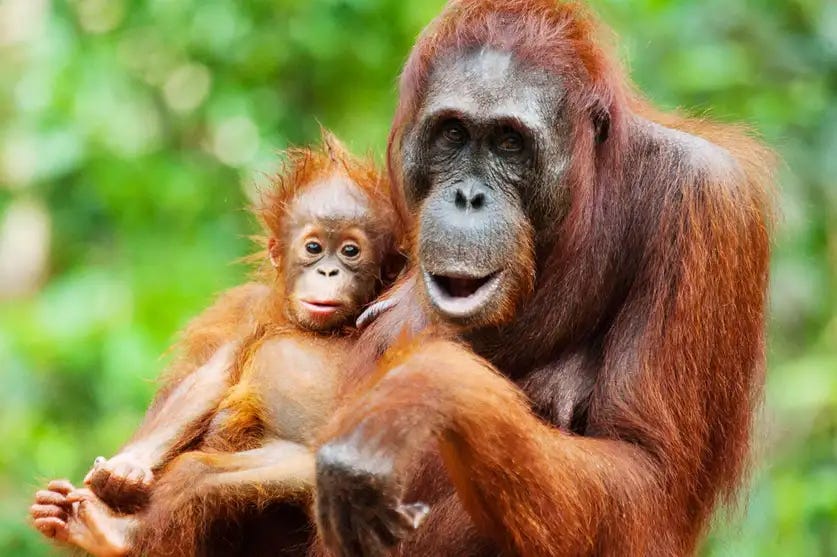
There is a mother orangutan at Tuanan Research Station in Central Kalimantan named Mindy. On one afternoon in February, her movement track looks almost too legible to be an accident. The day before, she travels toward the range core of another mother named Jinak. The two infants meet and play. The day after, Mindy heads home. Plotted on a map, it doesn’t look like foraging. It looks like an errand.
That’s roughly the shape of the pattern a team led by Odd Jacobson at the Max Planck Institute of Animal Behavior documented across fifteen years and about 30,000 hours of observation1 of 31 wild Pongo pygmaeus wurmbii mother-offspring pairs. It’s a strange thing to find in this particular species, because orangutans are supposed to be the antisocial great ape. Adult females spend most of their lives alone with a single dependent offspring, born once every 7.6 years on average, the longest interbirth interval of any land mammal. They don’t groom each other. They don’t build alliances. When neighboring mothers do cross paths, the encounters are brief, infrequent, and by most measures costly rather than beneficial to the mothers themselves.
So why would an animal built around solitude go out of its way to undo it, over and over, for years?


