

There is a sound that an orangutan makes when you tickle it. It comes out in bursts, evenly spaced, unmistakably rhythmic. If you closed your eyes and heard only the timing, stripped of the pitch and the texture, you might not immediately place it. But you would recognize the pattern. It sounds, in its basic structure, like a laugh.
That is not a coincidence or a superficial resemblance. According to a new study in Communications Biology,1 the rhythmic structure underlying laughter has been present and conserved across all five lineages of extant great apes, including Homo sapiens, for at least 15 million years. The paper, led by Chiara De Gregorio, Marina Davila-Ross, and Adriano Lameira, is the first to conduct a comparative rhythm analysis of laughter across the complete set of living hominids: Pongo pygmaeus, Gorilla gorilla, Pan paniscus, Pan troglodytes, and Homo sapiens.
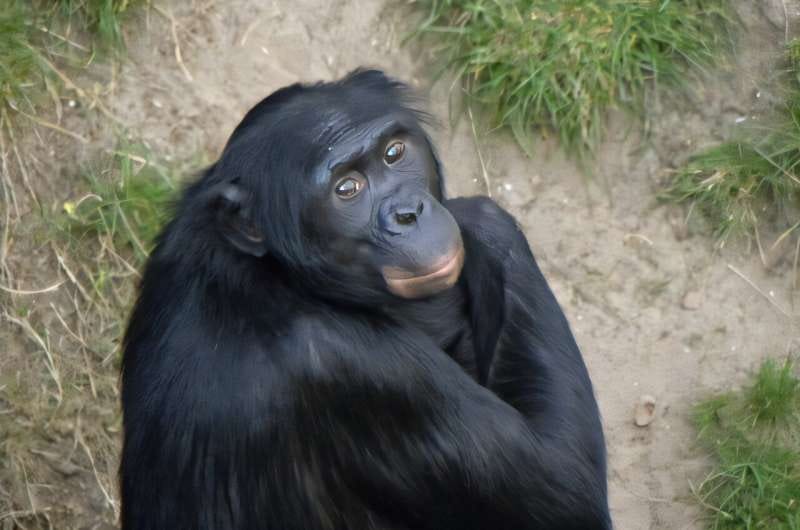
What they found is that every species laughs isochronously. The intervals between successive laugh bursts fall into a regular, evenly timed pattern, a 1:1 ratio between consecutive intervals. The “ha-ha-ha-ha” is not just phonologically similar across species. The beat is, at its core, the same.
An adolescent gorilla being tickled on his foot. The gorilla responds with laughter, pulls his foot away, but then presents his foot in order to be tickled some more. Credit: Dr. Marina Davila Ross
What Isochrony Reveals
Isochrony is a specific claim about timing. It means the intervals between sound onsets are metrically regular, not just roughly similar. Finding it in laughter across all five hominid lineages implies it was already present in the common ancestor from which orangutans diverged roughly 15 million years ago. The trait did not appear in chimps and then spread to humans, or emerge independently in multiple lineages. It was there from the beginning.
The team recorded 140 laughter bouts from 17 individuals across the five species, all young animals observed during playful interactions with familiar humans, in both tickling and spontaneous social play contexts. From these recordings, they extracted inter-onset intervals and computed what are called rhythmic ratios: the relative duration of one interval compared to the next. A ratio clustering around 0.5 indicates isochrony. Across all species, that’s what they found.
Bonobo laugh. Credit: Dr. Marina Davila Ross
Chimpanzee laugh. Credit: Dr. Marina Davila Ross
Gorilla Laugh. Credit: Dr. Marina Davila Ross
Orangutan Laugh. Credit: Dr. Marina Davila Ross
But the isochrony was not uniform across contexts. During tickling, laughter was highly regular. During social play, it deviated significantly. This is not surprising once you think about the mechanics: rough-and-tumble play involves torsion, compression, and impact on the thorax, which disrupts the respiratory cycle and with it the regular timing of vocalizations. Tickling laughter, produced without that physical interference, gave the researchers a cleaner window into the underlying rhythmic structure. It also gave them a methodological insight. If you want to study the evolution of the phonatory-respiratory system, tickling is the more stable condition.
The acceleration of laughter tempo across hominid evolution was also more clearly visible in tickling laughter than in play laughter. When the team modeled laughter tempo as a function of phylogenetic distance from Homo sapiens, the trend was statistically significant for tickling but not for play. The noise introduced by physical activity in social play effectively masked the evolutionary signal.
The Human Departure
Here is where humans become genuinely distinct, though not in the way that discontinuity narratives usually frame it.
Laughter has gotten faster across hominid evolution. It has also become more variable in its timing, with Homo sapiensshowing the highest coefficient of variation in inter-onset intervals of any species in the study. That variability is not random sloppiness. Research on human laughter perception suggests that variable timing is perceived as more socially and emotionally positive than rigid, stereotyped timing. A laugh that shifts and accelerates and varies across its duration reads differently from one that ticks along like a metronome. Humans have developed, it seems, not just faster laughter but more expressive laughter in the purely temporal sense.
More telling still is context sensitivity. Of all five species, only humans modulated laughter tempo according to context. When tickled, children in the study laughed faster than during social play. In the non-human apes, no such modulation was detected. This matters because it suggests an active, flexible vocal control that can respond to the social and emotional demands of a situation, rather than simply outputting a fixed motor pattern. The laughter you produce during tickling, where the rhythm is fast and regular, differs measurably from laughter in social play, and humans alone show that modulation.
This connects to a broader argument the study makes carefully. Human speech requires extraordinary fine-grained control over the timing and sequencing of vocalizations. That kind of control does not appear from nowhere. What laughter’s evolutionary record suggests is a long, gradual accumulation of rhythmic flexibility across the hominid lineage. Orangutans have isochronous laughter but little context sensitivity and relatively slow, consistent tempo. Moving along the phylogenetic tree toward the human branch, the rhythm becomes faster, more variable, and more responsive to context. Humans are at the far end of that trajectory, not standing apart from it.
Lameira and colleagues have been making versions of this argument for some time in relation to other orangutan vocalizations, including recursive vocal motifs and evidence of metered rhythm in Pongo song. What this study adds is comparative depth: every living hominid lineage, analyzed together for the first time, showing a coherent directional pattern across 15 million years of vocal evolution.
The study is appropriately cautious about sample sizes. Between two and four individuals per non-human species is a real limitation, and the authors acknowledge that future work with larger samples will refine species-level estimates of variability. The broader phylogenetic pattern is robust enough to survive that caveat, but species-by-species claims should be read with that constraint in mind.
What the data do not support is the older picture, still implicitly present in some accounts of language evolution, of a dramatic threshold crossing. Under that view, the crucial changes in vocal control were essentially a Homo sapiensdevelopment, qualitatively different from anything that came before. Laughter’s rhythm suggests something less abrupt: a long, incremental refinement of the same capacities that every great ape already possessed in some degree, with the human branch extending a trend rather than initiating one.
Sound does not fossilize. You cannot dig up a vocal tract from two million years ago and play it back. What you can do is listen to what all living hominids share, and trace the variations in what they do differently. The rhythm in an orangutan’s laughter during a tickling session is carrying information about a common ancestor that most people have never thought about. It is not a quaint analog of human behavior. It is a data point from 15 million years ago, still audible.
Further Reading
Davila-Ross, M. J., Owren, M., & Zimmermann, E. Reconstructing the evolution of laughter in great apes and humans. Current Biology 19, 1106–1111 (2009). https://doi.org/10.1016/j.cub.2009.05.028
De Gregorio, C., & Lameira, A. R. Twice times two: dual mechanism for double rhythmic meter in orangutans and the evolution of human song. iScience 29, 114273 (2026). https://doi.org/10.1016/j.isci.2026.114273
De Gregorio, C., Davila-Ross, M., & Lameira, A. R. Rhythm and timing in laughter reveal that human vocal plasticity falls on a hominid continuum. Communications Biology 9, 824 (2026). https://doi.org/10.1038/s42003-026-10499-z


