

A pygmy marmoset lives about seven and a half years. A chimpanzee, under good conditions, can live past forty. Put a human in the mix and you have nearly a tenfold span of median lifespans compressed into a single mammalian order. That degree of variation ought to tell us something about how aging works biologically, about which levers evolution has pulled and how recently.
A study published this month in Proceedings of the Royal Society B1 tries to answer exactly that question, and the answer is stranger than expected.
Eugene Melamud and colleagues at Calico Life Sciences, CleMetric, and the University of Wisconsin-Madison compiled lifespan records for 39 captive primate species from the Primate Aging Database, a decades-long accumulation of demographic data from zoos, research centers, and conservation sites across the United States and Europe. The dataset covers more than 12,000 individual animals, from lesser bushbabies to western lowland gorillas, with enough deaths recorded across most species to fit meaningful mortality models.
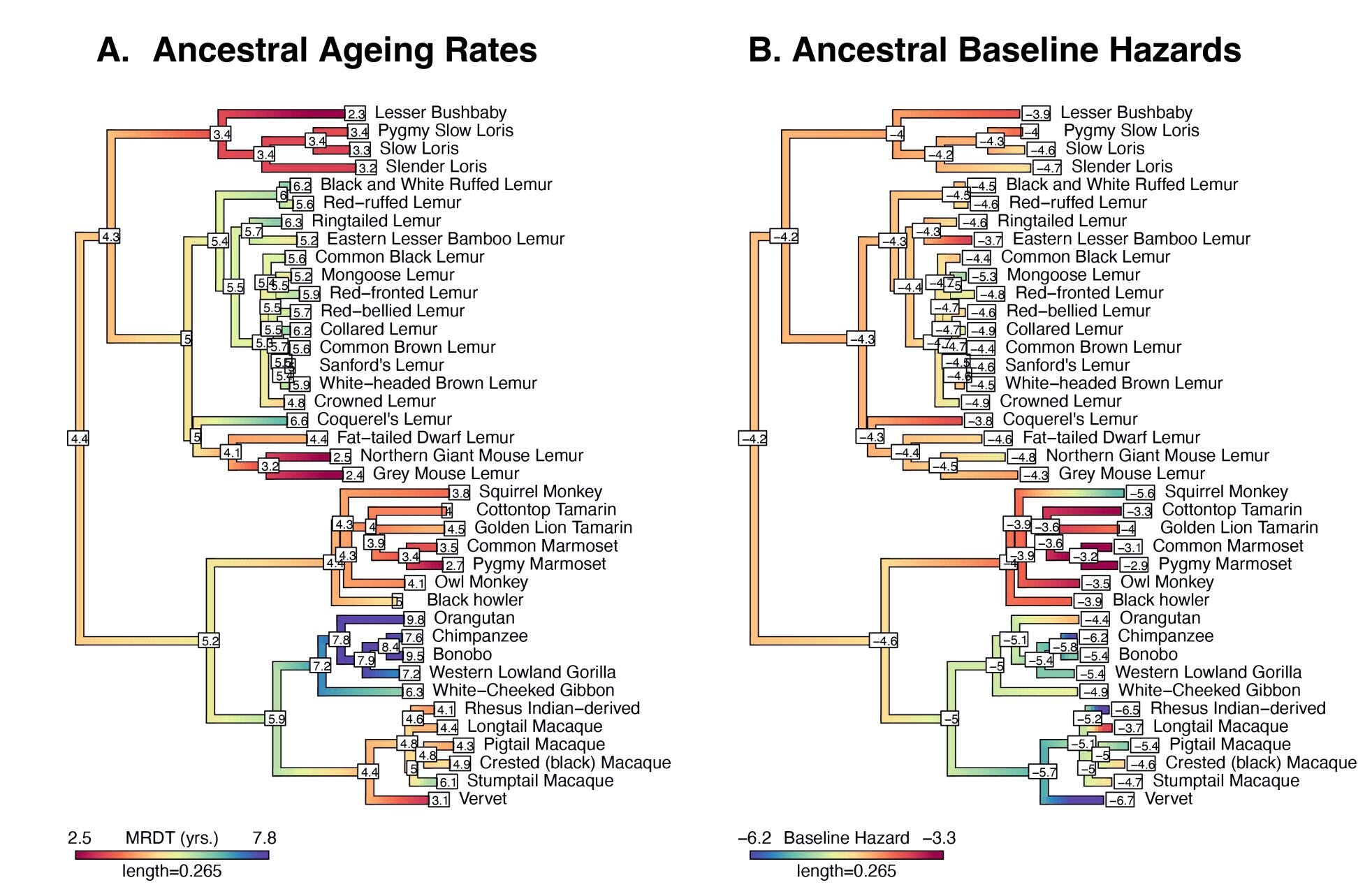
The framework they used goes back to 1825. Benjamin Gompertz, working from English mortality tables, noticed that the probability of dying doesn’t increase linearly with age — it accelerates exponentially. Starting around the time of sexual maturity, your risk of dying roughly doubles every several years. Gompertz captured this with a two-parameter model. One parameter, called the baseline hazard, describes how likely you are to die right at the onset of adulthood. The other, the aging rate, describes how quickly that probability climbs as you get older.
These two parameters are mathematically distinct and, it turns out, evolutionarily distinct as well.


