

In a corridor at the Ngamba Island Chimpanzee Sanctuary in Uganda, a rope ran from one room to another, and at the end of the rope was a 60-centimeter tray with three bolts, each carrying a piece of pineapple about 3 by 7 centimeters. A chimpanzee in the far room could pull the rope and take the tray away from whoever was eating from it. Every chimpanzee in the study did exactly that, without exception, in every one of the familiarization trials where nobody was on the other side to lose the fruit. The interesting data begin when someone was.
The belief this work disturbs is a comfortable one, and it is held by most readers who have thought about chimpanzees at all: that the animal in front of the tray is a calculator, weighing fruit against retaliation, and that whatever restraint it shows is the residue of fear. The published literature has leaned that way for years. Chimpanzees do not appear to respect ownership in any formal sense; in one 2020 experiment by Patricia Kanngiesser and colleagues, the participant allowed to monopolize a set of food rewards did so in 95% of trials. In an earlier tray-and-rope experiment by Keith Jensen, Josep Call and Michael Tomasello, theft occurred in 74% of trials, and the victims took revenge by collapsing the tray so that neither animal got the food. If chimpanzees steal whenever theft is cheap, then a chimpanzee that doesn’t steal must be afraid of something.
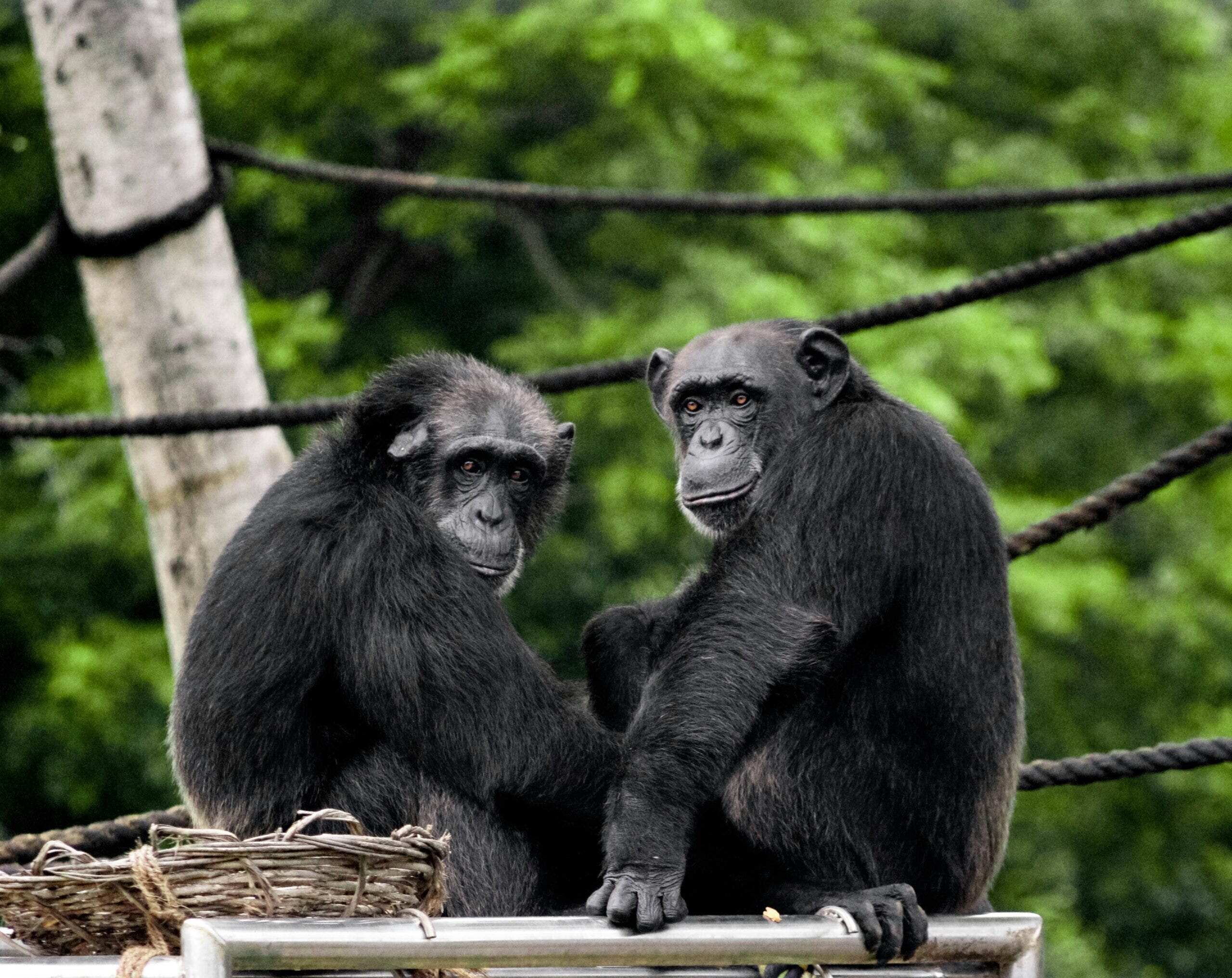
A study published this September in Evolution and Human Behavior,1 led by Oded Ritov, a doctoral student in psychology at the University of California, Berkeley, adds a wrinkle that fear alone has trouble explaining. Twenty-six chimpanzees (fourteen females and twelve males, aged 16 to 39) were paired with a friend and with a non-friend, and the same animals were tested in both conditions. Thieves pulled the tray in 61% of trials with friends and 70% of trials with non-friends. Nine percentage points is a modest gap, and the authors report it as significant (χ²(1) = 7.57, p = 0.006) across 138 trials, in a design where each victim sat through one session of three trials with a friend and one with a neutral peer.


