

On March 16, 2005, at the foot of the Serra do Aracá in the Brazilian state of Amazonas, Jean Boubli collected an adult male red howler monkey. The animal went into the mammal collection of the Instituto Nacional de Pesquisas da Amazônia in Manaus as specimen INPA-MAM5715. Twenty-one years later it has become the holotype, the single specimen to which a scientific name is formally anchored, of a new howler monkey species called Alouatta iroi.
That is not where most of us expect new primates to come from. Howler monkeys are among the most widespread primates in the Neotropics, the paper naming the new species calls them ubiquitous in Amazonia, and their behavior and ecology have been studied extensively. The working assumption has been that the species list for a primate this familiar was more or less complete at 13, and that the open questions were about how those 13 relate to one another.
What are the two new howler monkey species?
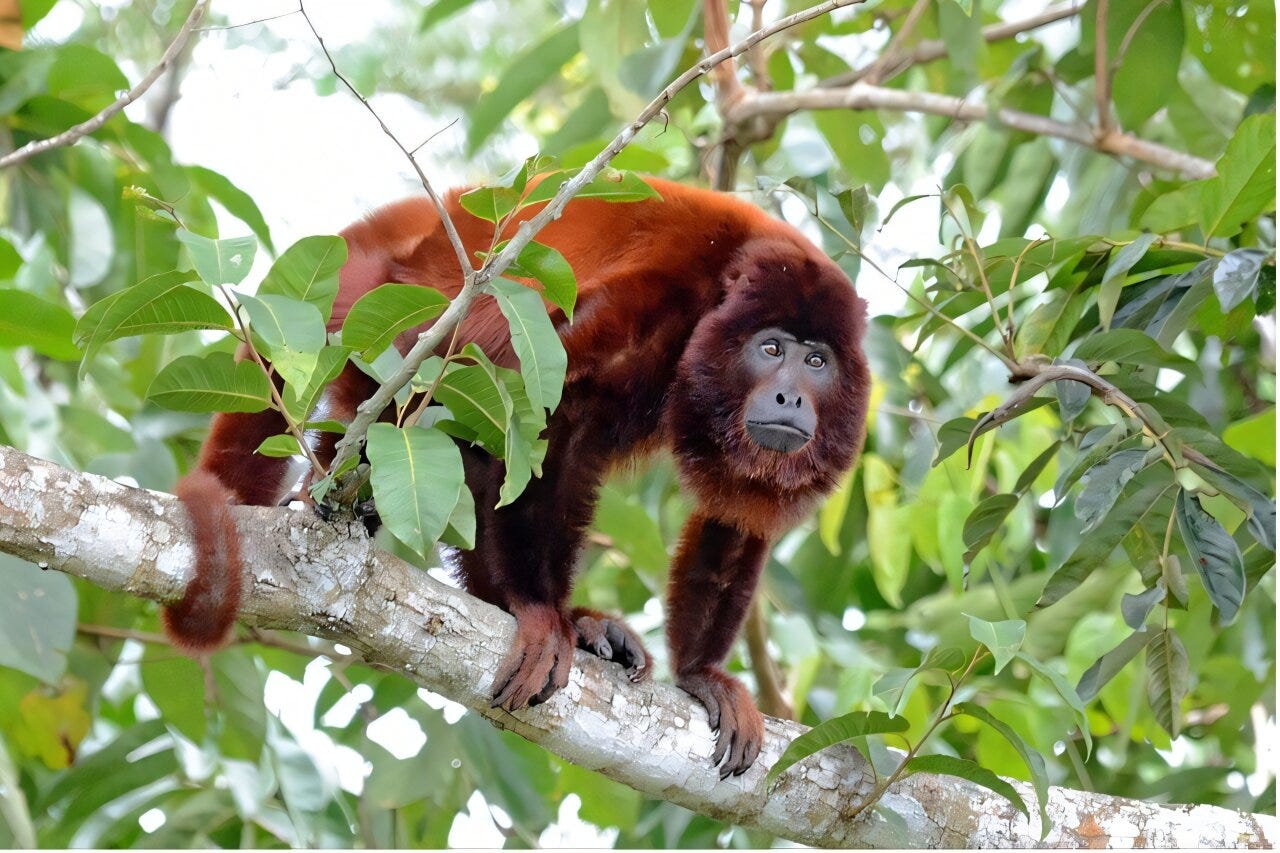
The paper, published in Communications Biology1 by a large team led by Romina Batista and Jean Boubli of the University of Salford, names two. A. iroi, which the authors call the Pantepui red howler, lives in northwestern Amazonia between the Rio Cauaburi and the Rio Branco, north of the Rio Negro. Alouatta matogrossensis, the Mato Grosso red howler, lives in southern Amazonia between the Rio Madeira and the Rio Teles Pires. Each is estimated to have split from its closest relative about 0.7 million years ago (Mya), and those are the two most recent splits the authors date anywhere in the genus.
The same analysis removes names as well as adding them. Alouatta puruensis is folded into A. juara as a junior synonym, meaning a later name for a species that already had one, and the howlers between the Tapajós and Xingu rivers that were called A. discolor become A. tapajozensis. With the Trinidad howler, A. insulanus, also counted as a species, the authors recognize 16 howler species where the taxonomy they started from had 13.


