

On 6 June 2004, in square 789/-979 of the Lower Berm excavation at Schöningen, in Lower Saxony, a tooth came out of lakeshore sediments just south of the area the team calls the “Speer Sockel.” It measured 7.47 millimetres from front to back. The excavators were then in the third of five seasons that would cover roughly 450 square metres and yield about 520 finds, mostly horse, rhinoceros and deer bones, flint artefacts, and burnt and charred wood. A paper published online on 10 September 2026 in Quaternary Environments and Humans1 identifies the tooth as the upper fourth deciduous premolar of a Barbary macaque, or something very close to one (the authors write Macaca cf. sylvanus, the “cf.” marking their caution).
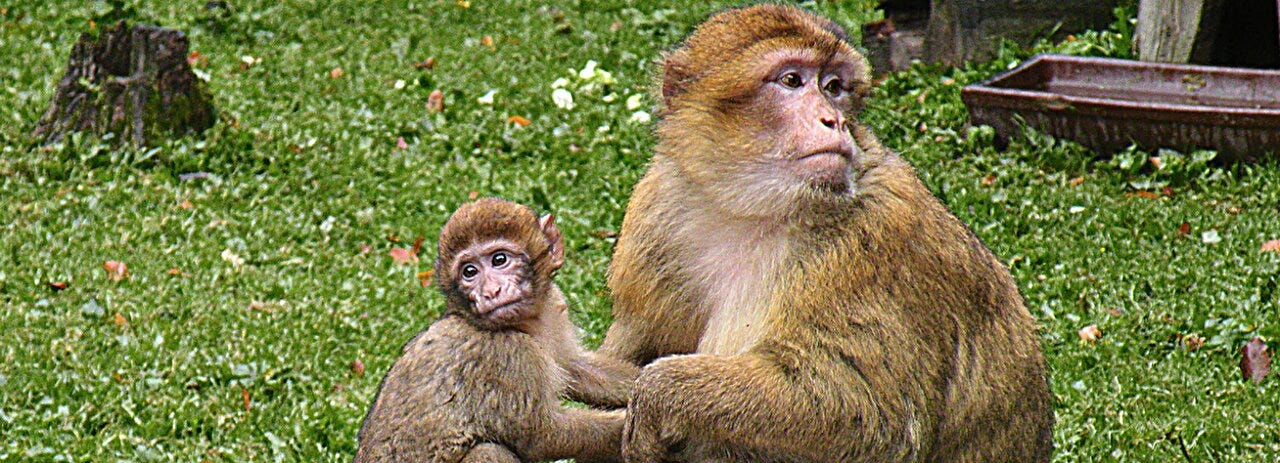
Most readers who know the Barbary macaque at all know it as the “ape” of Gibraltar, a population that humans introduced, and perhaps as a species of the Atlas Mountains, where something like 8,000 survive in the forests of Morocco and Algeria, up to 2,300 metres. The mental picture of Middle Pleistocene Germany is a different animal list: aurochs, horse, giant deer, a cold steppe with a few trees. Monkeys do not belong in it. Thijs van Kolfschoten, of the Faculty of Archaeology at Leiden University, who led the study, puts the distance plainly in the accompanying release: Schöningen lies about 1,800 kilometres north of where the species lives today.
The tooth matters beyond the map, because it was found in a layer that also holds evidence of people. Hominins were working flint and burning wood on the same shore, and the authors, who include Jordi Serangeli of the University of Tübingen’s Senckenberg Centre for Human Evolution and Palaeoenvironment, who directs the Schöningen excavations, and Ivo Verheijen of the Lower Saxony State Office for Cultural Heritage, name increased human predation as one possible reason the species later vanished from Europe. They give it as one candidate alongside vegetation change, and they do not claim to be able to separate the two.


