

At the Suaq Balimbing monitoring station, in Gunung Leuser National Park in northern Sumatra, field teams spent 12 years following young orangutans. Among a great many other things, they wrote down every time one of them spent a long stretch handling some object, often destructively, or tried to eat something and failed to get it down. They logged 4,649 of these bouts across 21 animals. Only 414 of them came more than 145 minutes after the youngster had last stopped to watch, closely and at length, what another orangutan was doing.
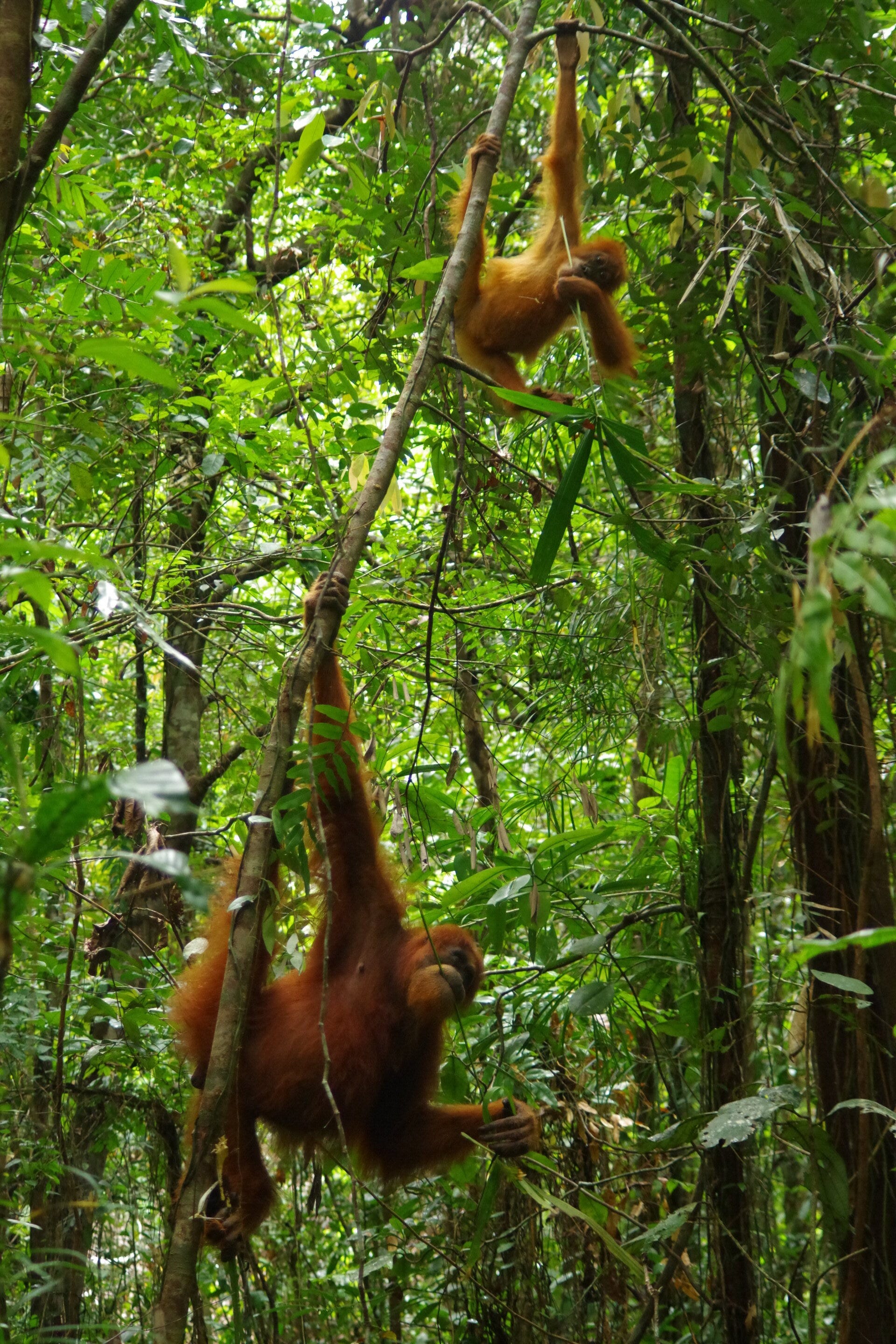
A young ape alone on a branch with a hard fruit and a stick looks like the plainest possible case of an animal teaching itself. Most of us would file it that way, and so would a good share of the research on animal culture. That research has long sorted learning into two bins: social learning, picked up by watching others, and individual learning (sometimes called asocial), worked out by trial and error. The Suaq records suggest that the ape on the branch is usually still under the influence of something it saw. A single bout of watching can keep its hands busier than usual for more than two hours after it has looked away.
The study was published in Science1 on 24 September 2026. It was led by Revathe Thillaikumar, a Marie Skłodowska-Curie postdoctoral fellow at the Max Planck Institute of Animal Behavior in Konstanz, Germany (the paper credits her as T. Revathe). The senior author is Caroline Schuppli, who leads the institute’s Development and Evolution of Cognition Research Group. The learning data come from more than 1,700 hours of direct observation of 21 immature Sumatran orangutans (Pongo abelii), aged between about six months and eight and three-quarter years when they were watched. Two learning behaviors were counted. Peering is the field term for sustained, attentive, close-range watching of another orangutan, either the mother or another animal nearby, and the team treats it as the visible trace of social learning. Exploration, their marker for individual learning, is the handling and failed eating described above. Over the 12 years the team recorded 2,113 bouts of peering to set against the 4,649 of exploration.
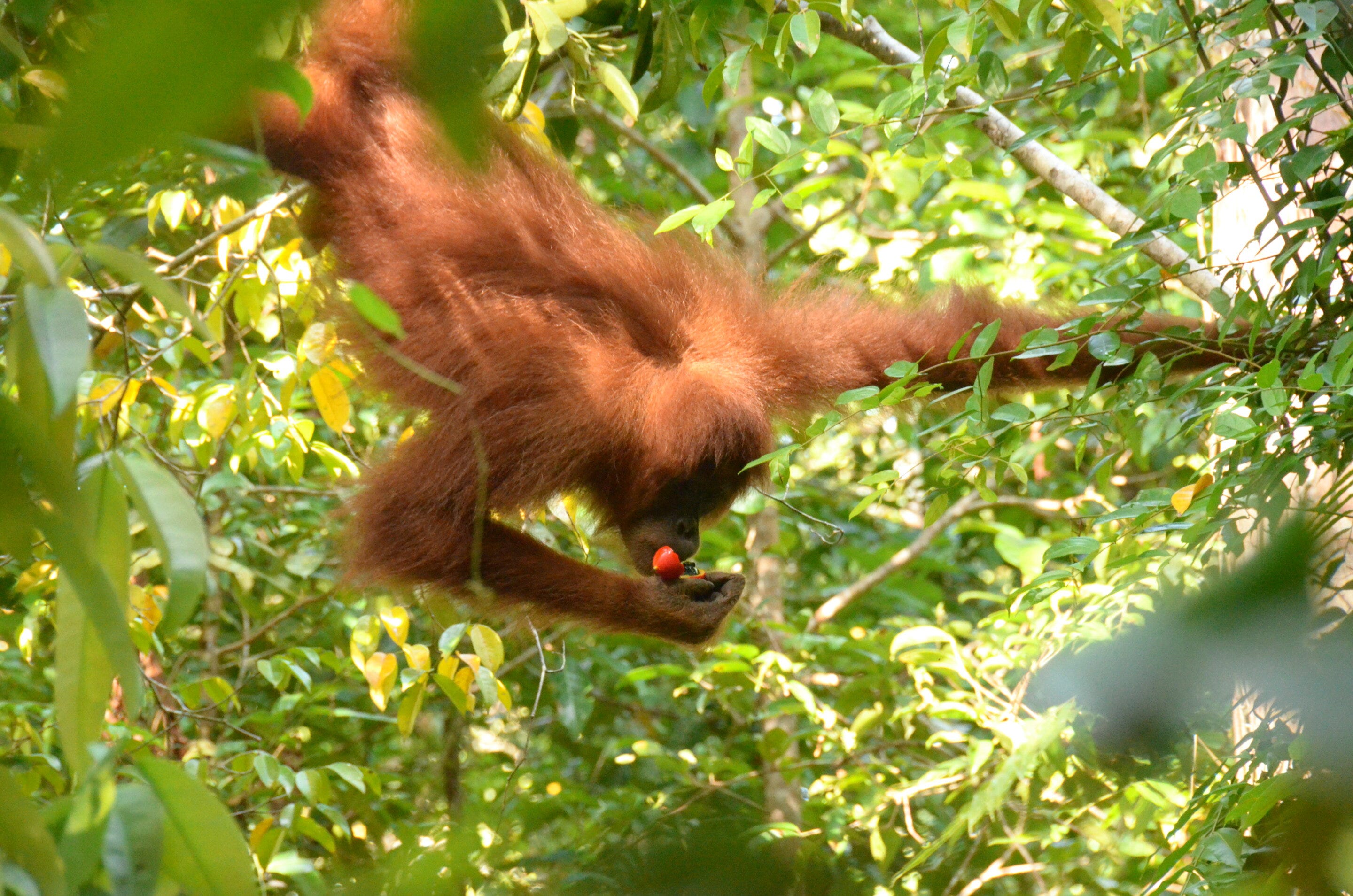
A Sumatran orangutan infant is exploring a Neesia fruit by biting it, holding it, and placing it securely in the space between the trunk and branch of a tree, and then kicking it in an (unsuccessful) attempt to break open the fruit. Credit: Zul Zulmaidi, SUAQ Project
The reason to count stares and fumbles for that long is food. An adult Sumatran orangutan eats around 250 different items, picked from thousands of possibilities in the forest. Many of them need processing and a few need tools, and a youngster has about eight years at its mother’s side to learn them. The team measured how ready an animal was by the number of distinct foods it ate without its mother’s help by independence, which they call diet breadth. Nobody had measured how watching and exploring add up to that number in a wild animal, partly because years can separate a learning event from any change in an orangutan’s diet.


