

In January 2020, a primate sanctuary in Texas confirmed that simian retrovirus type II had reached its Japanese macaques (Macaca fuscata). The paper’s account is that the virus arrived with a long-tailed macaque (Macaca fascicularis) taken in after retiring from biomedical laboratory research, an animal with no symptoms. The outbreak that followed killed some monkeys quickly through severe hemorrhage and left others with chronic immunodeficiency. A new study of pathogen avoidance in these animals turns on how the virus moves: through blood and saliva, by bites and scratches, with fecal-oral transmission never documented.
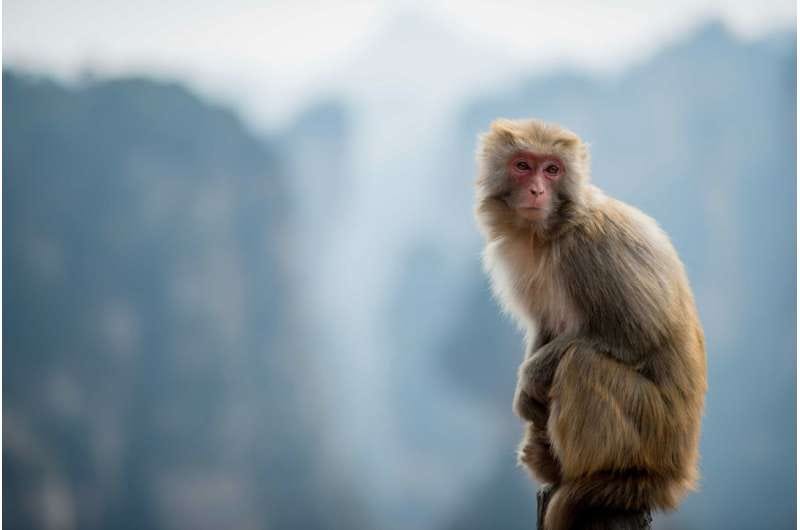
Between October 2022 and March 2024, the team set grape halves on a piece of wood and on macaque feces sealed under clear epoxy and recorded which monkeys ate from which. The usual assumption is that a monkey’s wariness of feces is a fixed reflex, set by evolution and indifferent to personal history. Tightening up after a disease scare is supposed to belong to humans, whose disgust the authors describe as shaped by genetics, learning and culture. They cite human studies reporting that disgust sensitivity rose during the COVID-19 pandemic (Stevenson, Saluja and Case, 2021). The open question was whether a macaque recalibrates in the same way, including toward a cue unrelated to how its own disease spreads.
Stephan Kaufhold, Amanda Goguen, Kyliegh Viano and Federico Rossano report two studies in Royal Society Open Science (2026).1 In the outbreak study, 55 Japanese macaques from four enclosures were tested, and three of the enclosures had lived through the outbreak. In trials where a monkey could take both grapes, animals from exposed groups ate from the feces-coated surface in 47% of trials (55 of 117), against 79% (63 of 80) for the one unexposed group. A second study of 54 macaques from seven species (one of them a hybrid) found that sanctuary-born animals raised by their mothers took food from feces less often than former pets. I find the outbreak result a real lead and the rearing result a weak one, for reasons that come down to a design with one control enclosure and no measurements from before the outbreak.
A Japanese macaque from a group that experienced a deadly disease outbreak encounters two pieces of food—one placed on a clean surface and one placed on a surface with a visual cue of contamination. In this trial, the macaque passes on the food from the contaminated surface. The behavior is part of a UC San Diego study, "Early-life experience and disease exposure affect pathogen avoidance behaviour in macaques," by Stephan Kaufhold and Federico Rossano of the Department of Cognitive Science at the UC San Diego School of Social Sciences. Credit: UC San Diego


