

In the forest around Bossou, Guinea, a respiratory epidemic during the 2003 dry season killed five of the community’s 19 chimpanzees, and one of the dead was Jimato, an infant about 1.2 years old and the eighth born to a female named Jire. Jire carried her dead infant for 68 days. In that time the body swelled and then dried out, lost its hair, and became a small shape wrapped in leathery skin, and a photograph taken 17 days after the death shows Jire carrying it on her back, one arm held between her shoulder and her neck. She groomed it and drove off the flies that gathered around it, on two occasions using a tool. By the time she abandoned it, the long carrying had destroyed much of the skull and left the face unrecognizable, although the fingers and toes survived inside the dry skin. That description comes from Dora Biro, then a zoologist at the University of Oxford, and her colleagues, who published it in Current Biology in 2010.
Almost anyone reading that account sees grief in it, and behind the grief a mother who knows exactly what has happened. The reading has support among researchers. A team at Gombe National Park in Tanzania, led by Elizabeth V. Lonsdorf, then of Franklin and Marshall College in Lancaster, Pennsylvania, reported in 2020 that mothers there carried infant corpses at high rates even though their behavior suggested they recognized the deaths, and Lonsdorf proposed that the behavior might resemble human grief. The assumption most readers bring to Jire’s story goes a step further, to the idea that a mother who carries a body for two months must understand that her infant is gone for good. A new study in Biology Letters1 by Reece Hammond, a doctoral candidate, and Thomas A. Püschel, the Wendy James Associate Professor in Evolutionary Anthropology, both at the University of Oxford’s School of Anthropology and Museum Ethnography, finds that nothing in how long chimpanzee and bonobo mothers carry their dead requires that understanding, though nothing in it rules the understanding out either.
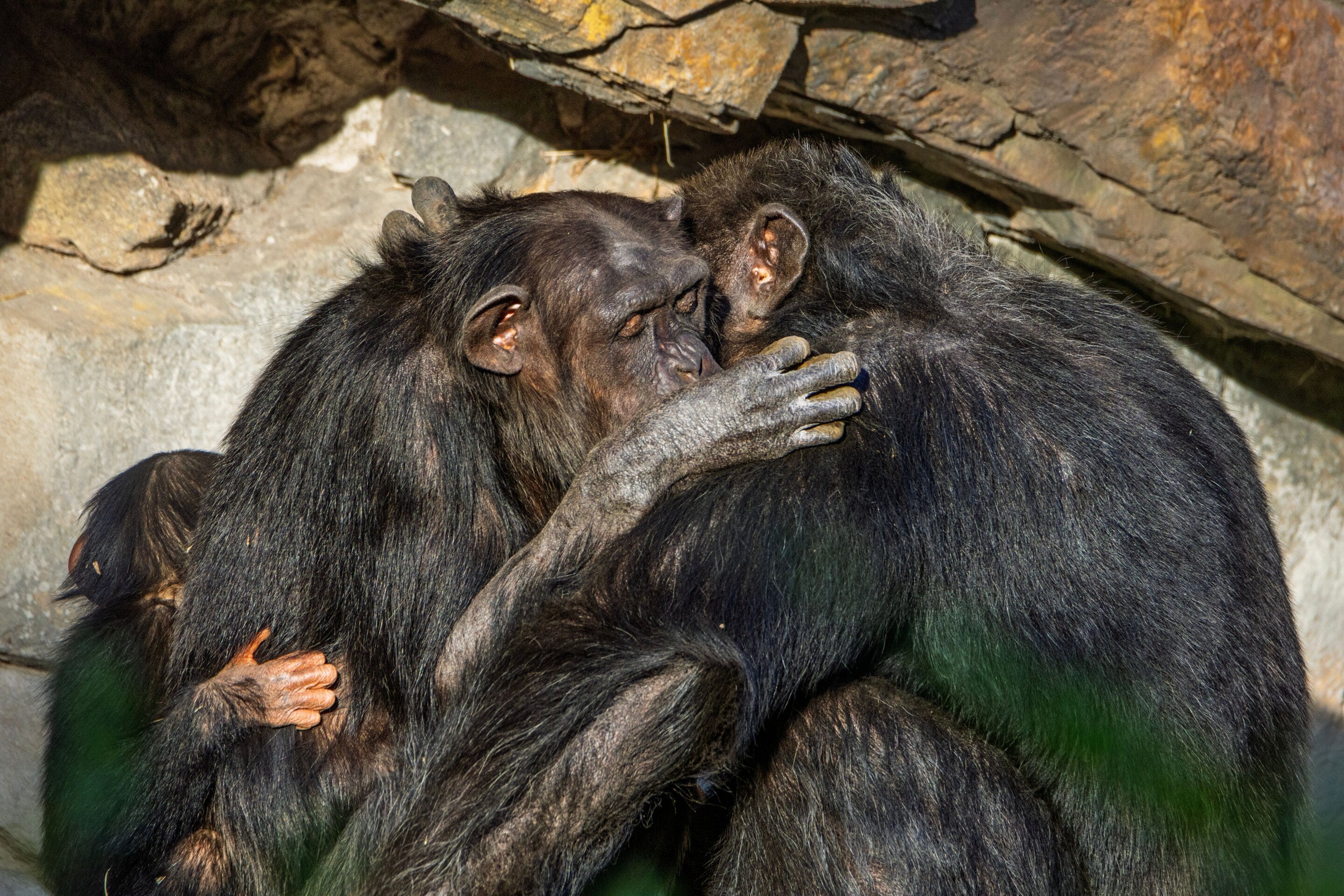
Chimpanzees and bonobos, the two living species in the genus Pan, are the closest living relatives of humans, and most researchers place the last ancestor all three shared somewhere between 6 and 8 million years ago. Primatologists study how Pan behaves around its dead because doing so helps separate the human responses to death we probably inherited from those that arose only in our own lineage. One part of a fully developed human concept of death is the knowledge that death cannot be reversed. If the length of an ape mother’s vigil can be explained without that knowledge, then the knowledge may be a later arrival, something that took shape among hominins after our line split from theirs (a possibility the Oxford authors put forward carefully, and which their data can support only indirectly).


