

In the first intron of a gene on chimpanzee chromosome 19 there is a stretch of retroviral DNA 6,915 nucleotides long. It is a copy of PTERV1 (Pan troglodytes endogenous retrovirus 1), a retrovirus thought to have infected the ancestors of African apes about 5 to 7 million years ago. A new paper in Science Advances1 argues that this one copy keeps a long noncoding RNA called LINC00662 (a gene whose product is an RNA never translated into protein) switched off in chimpanzee neural cells. The same gene is active in human cells, and PTERV1 is completely absent from the human genome.
I think most educated readers still carry a picture in which human and chimpanzee brains differ because our genes differ, with altered proteins building a bigger cortex. The authors start from a statistic that strains that picture: humans share more than 96% of protein-coding sequence with chimpanzees, yet the human brain is roughly three times the size. A second assumption, one I suspect many people outside genomics hold, is that endogenous retroviruses (inherited remnants of ancient infections) are inert genomic fossils. This paper tests one case where a fossil appears to be doing something.
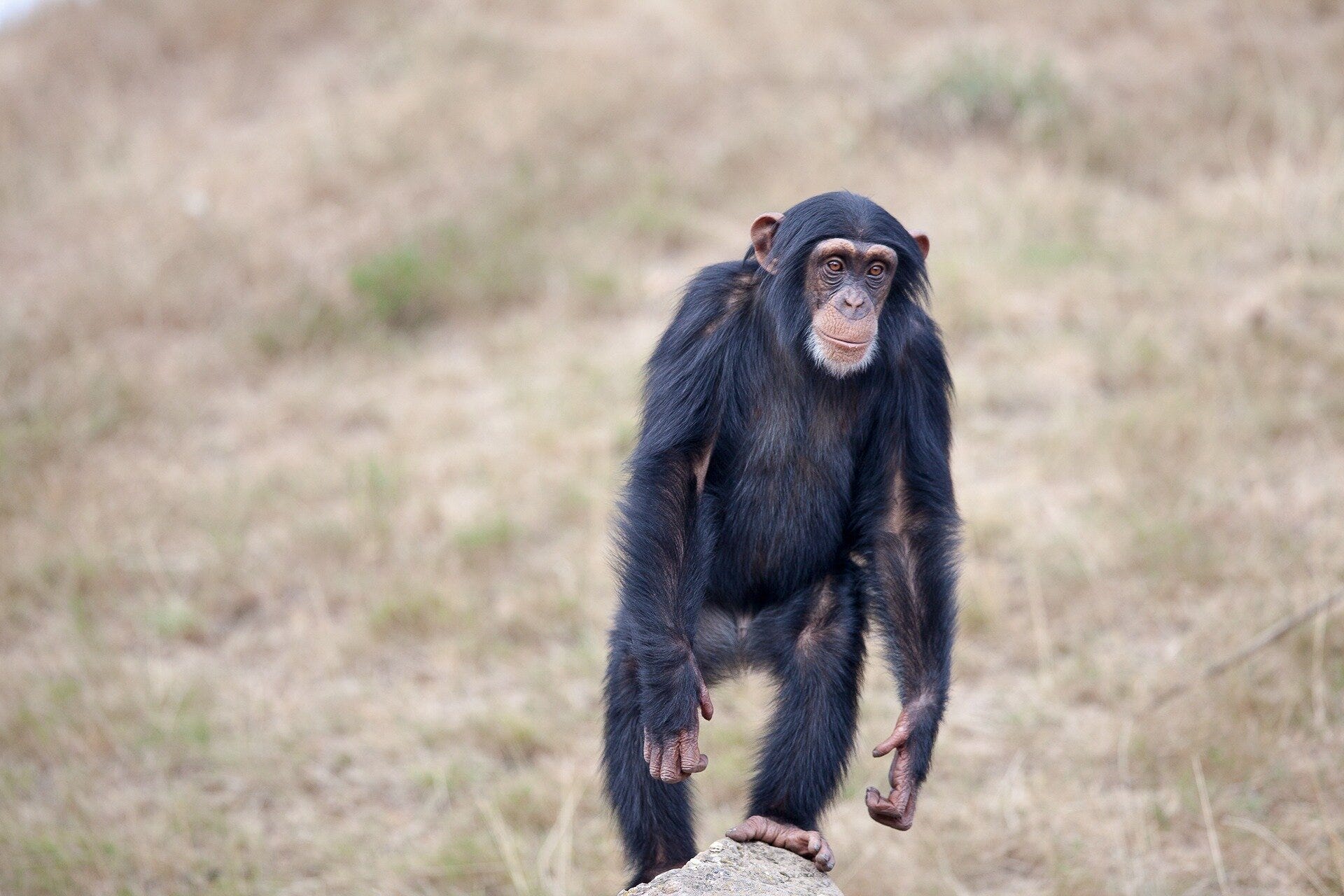
The study comes from a Lund University group led by Johan Jakobsson, the corresponding author, with Patricia Gerdes, Ofelia Karlsson, Raquel Garza and Diahann A. M. Atacho as equally contributing first authors. It was published as Science Advances 12(43), eaeg5791, on 23 October 2026. The team found 158 PTERV1 elements in the chimpanzee reference genome, and almost all were methylated (chemically tagged for silencing) in chimpanzee stem cells and early organoids. They followed up the insertion that overlaps LINC00662, which was silent in chimpanzee organoids and active in human ones. Cutting the insertion out of chimpanzee stem cells turned the gene back on, and silencing the gene in human organoids lowered a marker of neurite growth at day 30. In one sentence: the paper documents a lineage-specific retroviral insertion that appears to explain a human-chimpanzee expression difference in a gene with a plausible role in neuron maturation, and it does not show that this mattered for brain evolution.


