
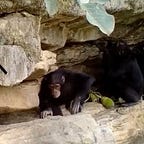
On February 3, 2018, at an army ant nest in southeastern Senegal that researchers call TS1, a chimpanzee named Soukki, who had just dipped for ants with a stick four times, pushed the same stick back into the nest beside her daughter Saïsaï and left it standing there. Saïsaï was three and a half to four years old. When she wandered off, Soukki went after her, took her by the arms, and set her down in front of the stick, and Saïsaï pulled it out with her left hand and foot and ate the ants while her mother watched.
Teaching of that kind, where an adult changes what she does so that someone else can learn, is widely assumed to be a human specialty, and chimpanzees, in the familiar picture, learn tool use by watching and fumbling with nobody showing them anything. Christophe Boesch reported apparent teaching among nut-cracking mothers in Côte d’Ivoire’s Taï National Park in 1991, but such cases have stayed rare, and a study published on September 16, 2026, in Frontiers in Psychology1 adds two, with a tally that changes what chimpanzee teaching mostly looks like.
Soukki and Saïsaï are western chimpanzees (Pan troglodytes verus), a Critically Endangered subspecies, and they belong to a population of at least 53 adults in the Dindefelo Community Nature Reserve, more than 140 square kilometers of grassland and dry woodland in Senegal’s Kedougou region, along the border with Guinea. Nobody has ever fed or habituated them, so no one follows them with a notebook as Jane Goodall did at Gombe, in Tanzania; camera traps from Bushnell, Browning, and Wimius record a one-minute clip whenever something moves. Between 2017 and 2025, a team led by Andreu Sánchez-Megías, a doctoral candidate at the University of Barcelona who works with the Jane Goodall Institute Spain in Senegal, gathered 14 hours and 58 minutes of video at 14 spots where the chimpanzees fish for algae, dip for army ants, or fish for termites with sticks, and 30 minutes at 11 spots where they carry baobab fruit.
The question is whether giving away a tool costs the giver anything. In 1992 the biologists Tim Caro and Marc Hauser proposed that an animal teaches when it acts in a learner’s presence, pays a cost or at least gains nothing by it, and the learner learns, and in 2016 Stephanie Musgrave and colleagues used that test to argue in Scientific Reports that tool transfers among termite-fishing chimpanzees at Goualougo, in the Republic of the Congo, qualify.
The Dindefelo cameras caught 33 tool transfers, 19 during ant dipping, 10 during algae fishing, and four at termite mounds. Most of the chimps who started with the tool (initial possessors, in the paper; holders, here) were adults, and the largest group of recipients, 14, were infants. Of the 27 pairs that could be identified, 16 were relatives, eight of them mother to offspring. Soukki’s handover, which the paper classes as a proactive transfer, was the only one of the 33 that the holder started. In the other 32 the recipient moved first: 14 were recoveries, in which the recipient picked up a tool the holder had just set down and walked away from; three were fragments that fell from a tool still in use; 13 were tolerated takes, in which the recipient took the tool from the holder’s hands and the holder let go; and two were steals the holder failed to stop.
Ant dipping tool transfer. Credit: Jane Goodall Institute Spain in Senegal
Sánchez-Megías, who scored all the videos, compared each animal’s behavior in the 30 seconds before a transfer with the 30 seconds after, leaving out recoveries, since a chimp who has already walked away from a stick gives nothing up. Holders afterward spent less time using tools and made fewer insertions, while recipients spent more time with tools, made more insertions, and, in the stricter versions of the analysis, ate more mouthfuls per second. Of the 23 holders who stayed on camera long enough to follow, 13 quit using tools. The holders’ eating rate did not drop significantly, which the authors put down to small samples, and the strictest models rest on just four transfers.
The stick Soukki left was probably worth more than it looks, because the hard part of ant dipping at Dindefelo seems to be finding ants at all. The cameras at four ant sites logged 166 successful dipping events and 525 in which no ants were there, and a 2024 paper by Sánchez-Megías and colleagues in Communications Biology found that the chimpanzees remember the hidden underground nests of Dorylus army ants and return to check them across several years. TS1 is one they visit often. The ants bite, too; Soukki brushed them off her right leg on her way over to Saïsaï.
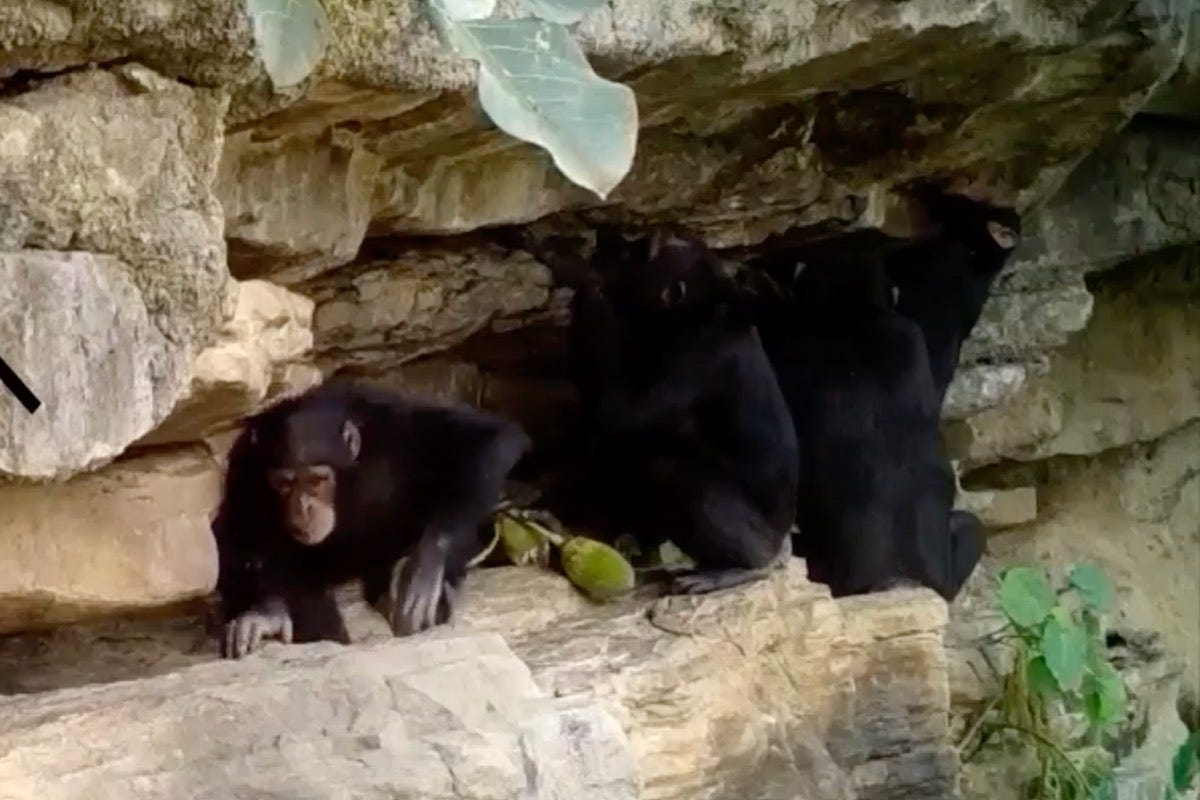
Baobab fruit transfer and pounding. Credit: Jane Goodall Institute Spain in Senegal


