

Between February 2014 and August 2023, observers following two habituated bonobo (Pan paniscus) communities at LuiKotale, in the Democratic Republic of the Congo, recorded 415 successful prey captures. Of those, 173 were ungulates, which at this site means almost entirely forest duikers, a group of forest antelopes. The new paper on bonobo hunting in Current Biology describes what separates a duiker in the hand from a monkey in the hand: primates typically die almost immediately after capture, while duikers survive much longer, and their distress calls draw party members from near and far. A bonobo holding a calling duiker is about to have company, and I think that one observation explains more about this study than any of its statistics.
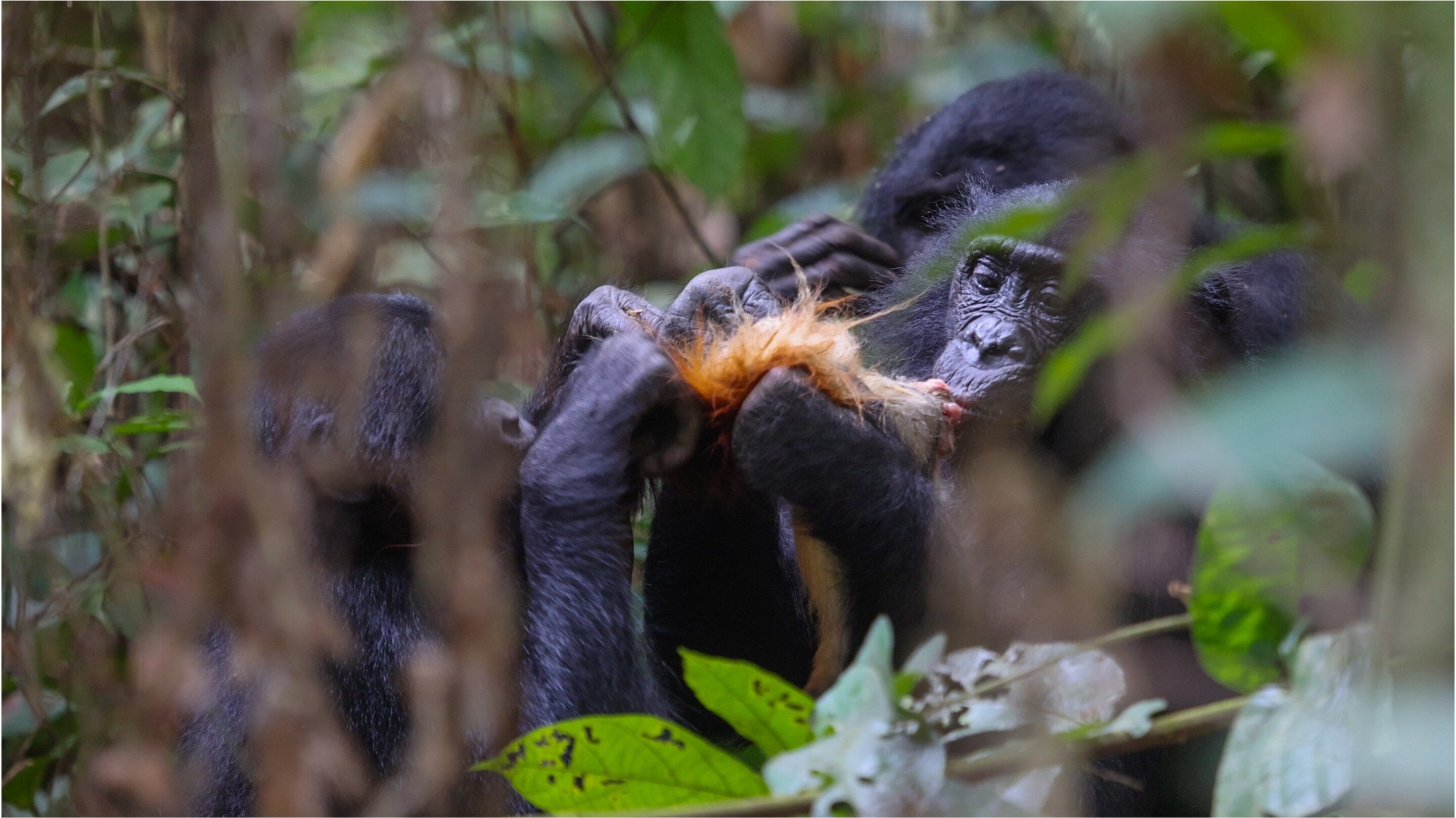
The belief the study is aimed at is that ape hunting is male work. The paper summarizes the chimpanzee (Pan troglodytes) pattern as hunting mainly by adult males, success rising with the number of adult males present, and meat sharing usually controlled by males. Because chimpanzees have been the main reference for reconstructing early hominin hunting, bonobos have served as the contrast case: hunts described as opportunistic captures of ungulates by individual females, set against the cooperative, male-dominated pursuit of monkeys in chimpanzees. The authors argue that this contrast is too tidy.
The paper, by Gottfried Hohmann, Mattia Bessone, Barbara Fruth and six co-authors, appeared as a Report in Current Biology (volume 36, November 16, 2026).1 I use “monkeys” below for its arboreal primate category and “duikers” for its ungulate category. Ungulates made up 42% of captures and arboreal primates 43%, with birds, rodents and other small vertebrates making up the remaining 15%, and red colobus accounted for 137 monkey captures, which the paper gives as 77% of primate prey. The hunter could be identified for 158 of the 415 captures. Of those, 99 (61.5%) were attributed to females and 59 to males. Adding up Table 2, females made 55 of the 73 identified duiker captures against 18 for males, and 30 of the 62 identified monkey captures against 32 for males.
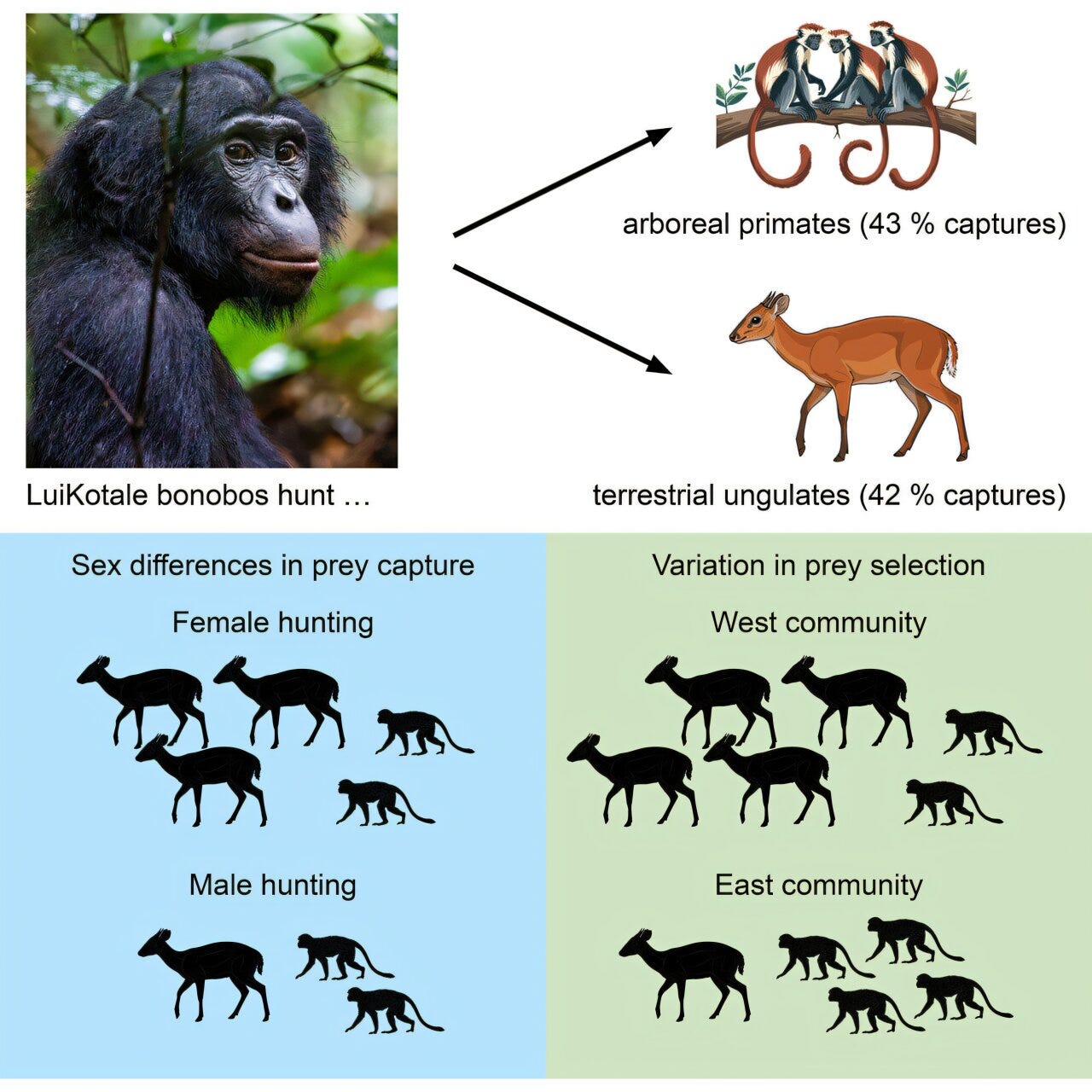
The authors read this as support for the idea that hunting activity follows intersexual dominance, with the dominant sex hunting more. The competing idea, traced in the paper to Gilby and colleagues (2017) on East African chimpanzees, is female risk aversion, which predicts females concentrating on duikers and males on monkeys. Because females and males caught monkeys at similar rates, the paper does not support risk aversion. This post asks how much of the dominance reading the numbers can carry, since the press release carries it further than the paper does.


