

In a macaque, the busiest single junction in what neuroscientists call the self-processing network sits inside the insula, a strip of cortex folded down behind the temporal lobe that also handles taste, pain, and the raw feeling of having a heartbeat or a full stomach. In a chimpanzee, that same busy junction has drifted, still recognizably in the insula’s neighborhood but pulled forward and toward the midline. In a human, it has moved again, largely out of the insula and into the cingulate cortex, the band of tissue that wraps around the corpus callosum like a belt around a waist. A new study in the Journal of Neuroscience,1 led by Ning Liu of the Institute of Biophysics at the Chinese Academy of Sciences, tracked that migration directly, scanning 46 human brains, 46 chimpanzee brains, and 43 macaque brains and comparing them region by region.
A hub, in the vocabulary of connectome research, is not a metaphor stretched to fit the data. It means a region carrying a disproportionate share of a network’s total connections, the equivalent of a major interchange on a map of highways rather than a quiet residential street. Finding one in a chimpanzee or a macaque brain at all required Liu’s team to solve a harder problem than the scanning itself: brains of such different sizes and folding patterns do not line up point for point, so the group built what they call a shared homologous connectivity space, using white-matter tracts known to be conserved across all three species as a common coordinate system. Onto that shared space they mapped the human self-processing network, a set of regions defined years earlier by a meta-analysis of self-referential brain-imaging studies (one of the paper’s co-authors, Georg Northoff, published an influential meta-analysis of exactly that kind back in 2006,2 cataloguing which cortical regions activate when people think about themselves). Translating that human map onto a chimpanzee brain and then a macaque brain was closer to translating a poem between languages that share only some of their grammar than to overlaying two photographs.
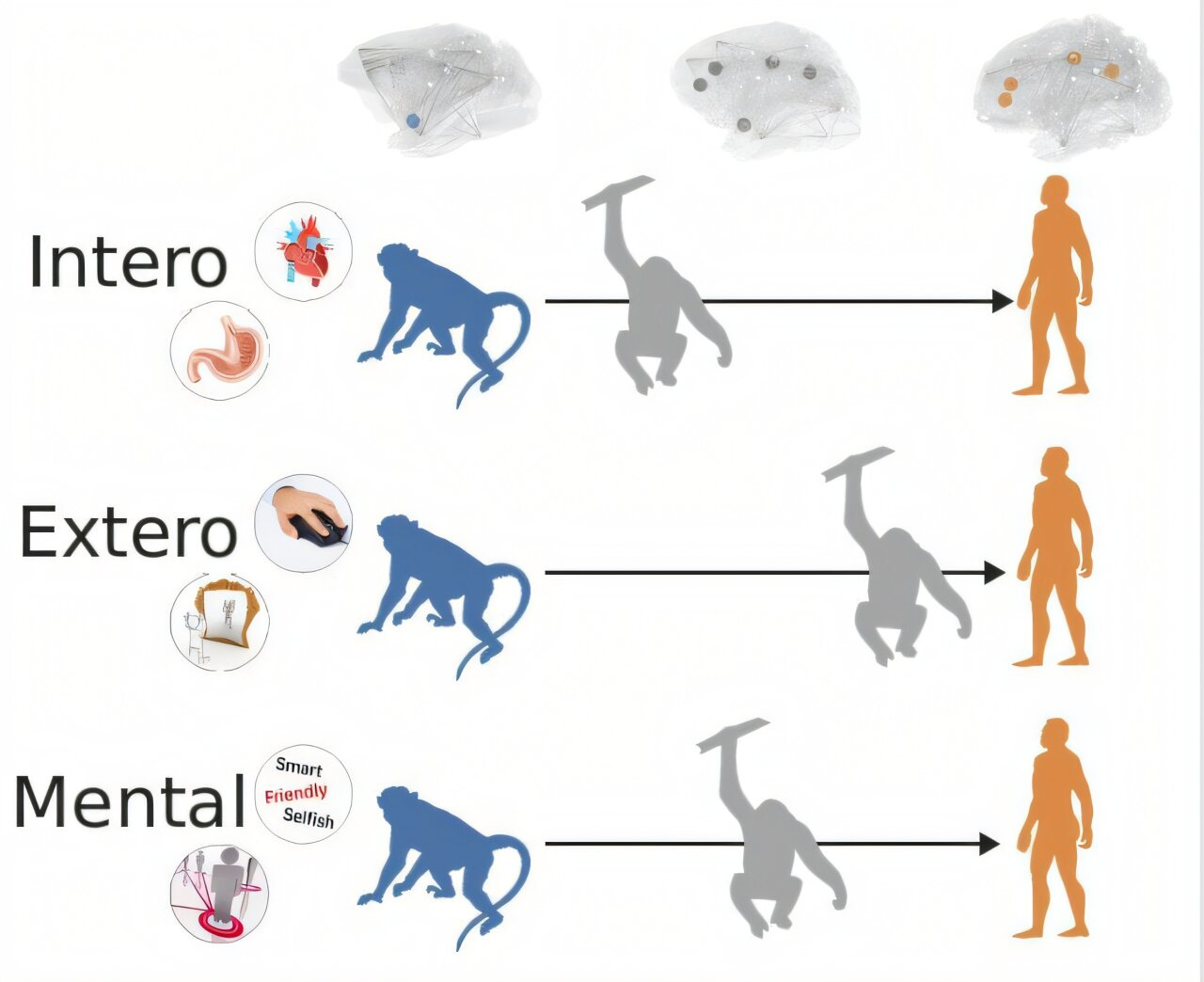
Self, as a scientific object, splits fairly cleanly into layers that philosophers noticed well before anyone had a scanner to test them. There is a layer concerned with the state of one’s own body: hunger, pain, the thud of a pulse. There is a layer concerned with where that body ends and the world begins, the sense that lets a hand recognize itself as a hand even in the dark. And there is a layer concerned with something more abstract: a self that persists across time, has a name, and can answer, in the first person, when asked what it wants for dinner. Neuroscientists label these, respectively, interoceptive processing, exteroceptive processing, and mental self-processing, and until this study nobody had a good answer for whether the three layers evolved together, as one package, or separately, on different schedules, in different species.
The answer, once Liu’s group had enough data to give one, was neither of the tidy options: local tissue, the raw biological material of the self-processing network, stayed almost unchanged across the twenty-five to thirty million years separating the ancestors of macaques from the ancestors of every living ape, while the wiring connecting that tissue into a working system was substantially rebuilt, and rebuilt unevenly, with different layers of the self changing on different schedules.


