

Between June 2022 and April 2023, in Phu Khieo Wildlife Sanctuary in northeastern Thailand, observers following five groups of wild Assamese macaques (Macaca assamensis) looked for a resting adult male with a clear view, from about five meters, of two other adult males coming within a meter and a half of each other. Then they timed how long he looked. In the 441 scenes where he did, looks ran from 1 to 49 seconds. In 160 the pair did something friendly, such as grooming or sitting in contact; in 182 there was conflict, with one male aggressive or submissive toward the other; the other 99, with no interaction, served as a baseline. Males were likelier to look at a conflict than at a friendly scene, yet how long they watched friendly scenes went more clearly with the strength of their own bonds.
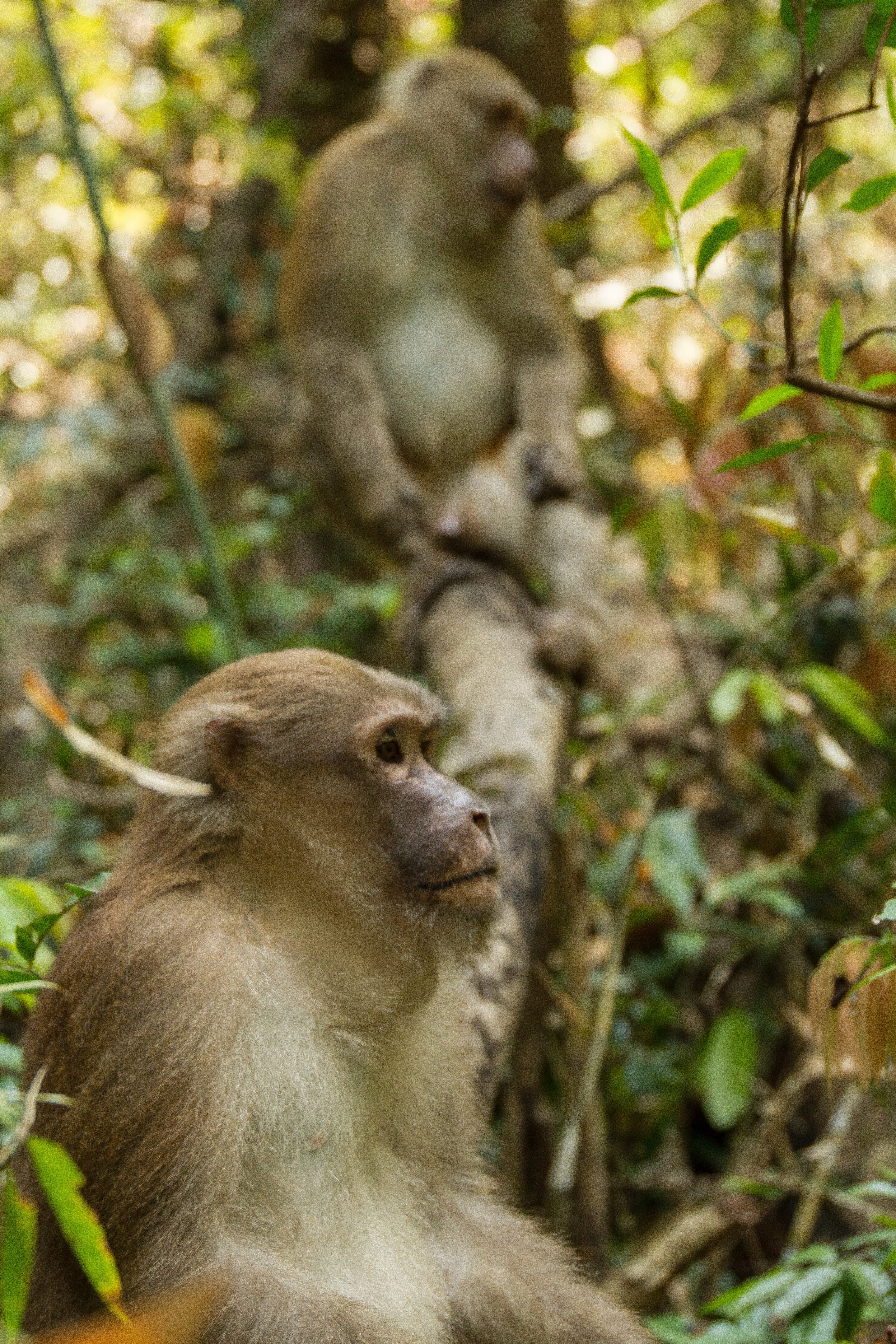
Primatologists have long assumed that this kind of watching pays. Monkeys and apes keep track of the relationships around them, and the usual inference is that selection favored such tracking because it helps an animal choose friends and allies. Evidence from wild animals tying individual differences in watching to anything that bears on reproduction has been scarce. A second assumption often comes with the first: that the watching worth doing is aimed up the hierarchy, at rank and conflict.
The study, by Sofia Pereira, Oliver Schülke and Julia Ostner of the University of Göttingen and the German Primate Center, with Suthirote Meesawat and Suchinda Malaivijitnond of Chulalongkorn University in Bangkok, appears in Current Biology.1 Among 46 adult males, those who habitually looked longer at other males’ friendly interactions had stronger bonds with other males at the end of the first study year. Those bonds went with higher dominance the following year, after accounting for where each male started, and higher dominance went with more observed copulations, about 19 percent more per standard deviation of dominance.
Pereira and her colleagues present this as a chain from watching to mating, but its links differ in strength. The new result, the tie between watching and bonds, is clearly supported, and the later steps repeat what Schülke, Ostner and colleagues found2 here in 2010. Two things are less settled than the paper’s framing suggests: whether watching comes before bonding, and whether watching friendly scenes matters more than watching conflicts.
How do researchers measure attention in wild monkeys?
The data come from a project that has followed the Phu Khieo macaques since 2005. Attention was scored for 56 adult males in the first study year; ten later moved to groups outside the study or disappeared, leaving 46. That first year ran sixteen months, from January 2022 to April 2023, and the second from September 2023 to March 2024. Over both, the team logged 2,819.6 hours of focal follows, about 50 per male, in which an observer stays with one male for 40 minutes and records every interaction he has and with whom.
Each male’s attention score came from a statistical model of looking time that adjusted for his rank, his relationships with the pair, the kind of scene and how long it lasted. The score is what statisticians call his random effect: how much longer or shorter than expected his looks consistently ran, computed separately for friendly scenes and conflicts.
The outcomes come from the same fieldwork. Bond strength uses the Dynamic Dyadic Sociality Index (DDSI), which starts every pair of males at 0.5 on a scale from 0 to 1, raises the score when they groom or sit in contact, and lowers it when either does so with another male; a male’s bond strength is the sum of his three highest pair scores. Dominance uses Elo ratings, which rise when a male wins a decided conflict (the loser bares his teeth, makes room or gives ground) and fall when he loses one. Mating success is the count of copulations observed in the second year, which earlier work here found to be a good predictor of male reproductive success.
Scores and outcomes went into Bayesian models built around a causal diagram, with predictors standardized so estimates within a model can be compared. Each estimate comes with a 95 percent credible interval, the range where the true value most plausibly lies; when the interval stays clear of zero, the direction of the relationship is not in much doubt. Attention to friendly scenes predicted end-of-year bond strength at 0.47, with an interval of 0.14 to 0.79. Bonds predicted second-year dominance at 0.22, with an interval reaching down to zero, though first-year dominance predicted it far better (0.77), as expected in a hierarchy that doesn’t reshuffle every year. Second-year dominance predicted copulations in the same months at 0.17 (interval 0.07 to 0.27), the basis of the 19 percent figure. A mediation analysis put the indirect path from watching to later dominance, through bonds, at 0.09, with an interval just touching zero, and found little sign of a direct path.
Does watching friendly behavior matter more than watching conflicts?
The paper’s highlights credit attention to friendly interactions with the stronger effect. For conflicts, the estimate on bonds was 0.22 (interval −0.11 to 0.55). The authors checked for artifacts and found that males had as much chance to watch conflicts as friendly scenes and varied about as much in how long they watched them. They suggest that whether a male looks at a conflict depends mostly on the situation, since any male nearby risks being drawn in, and that watching conflicts may pay off another way, by helping males avoid injury.
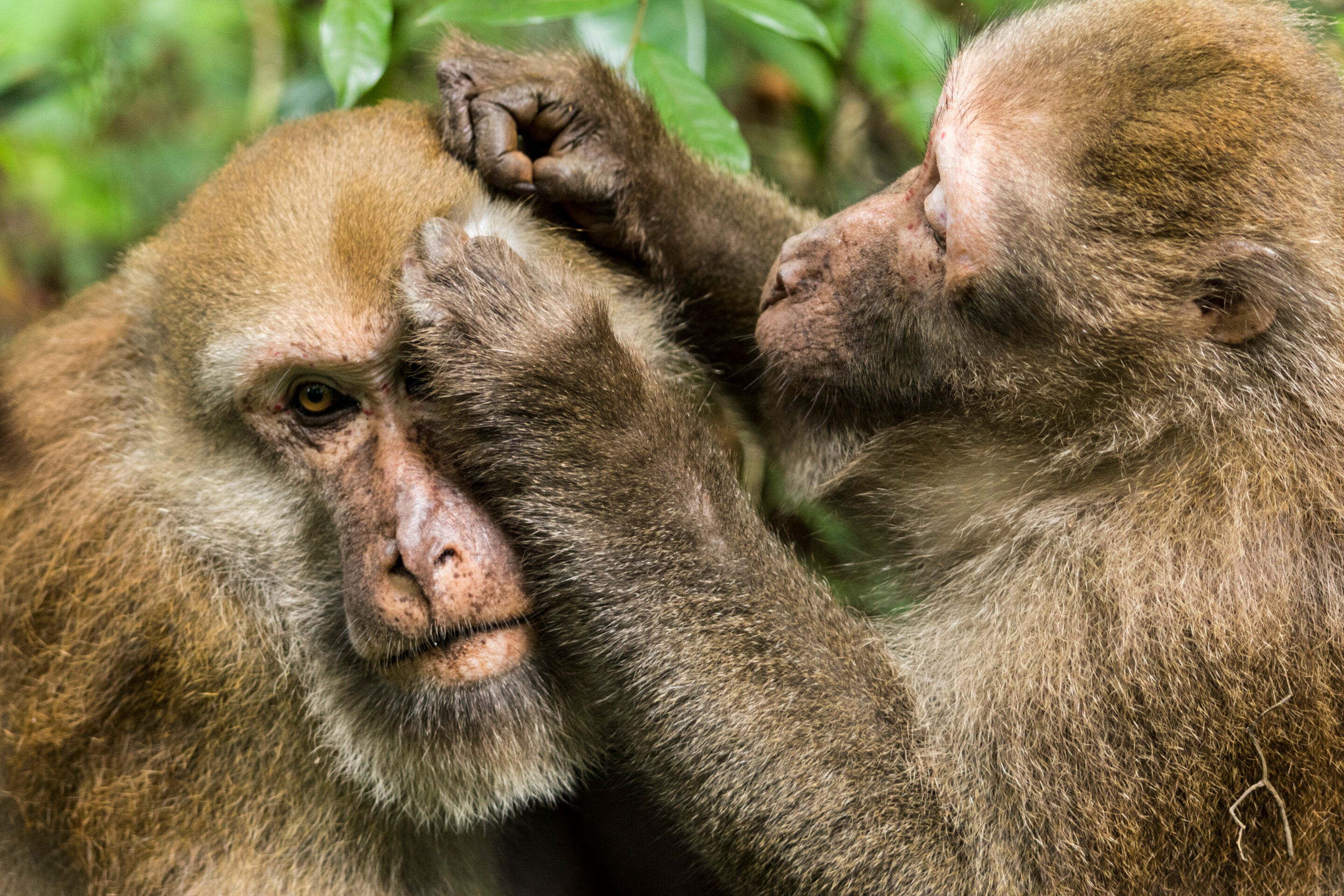
I’m not persuaded by the contrast, because the difference between the two effects is never tested. The conflict interval takes in the friendly-scene estimate of 0.47, so the data are compatible with both kinds of watching having similar links to bonds. For later dominance the comparison, if anything, runs the other way: with bonds left out of the model, conflict-watching has the larger estimate (0.14 against 0.07), though neither interval comes close to excluding zero. The press release’s claim that males all watch conflicts too similarly for the watching to matter runs against that same check; the low variation the authors describe is in whether a male looks at all.
What the Assamese macaque study can’t show
Timing is the weakest part of the causal story. Attention was scored from June 2022 to April 2023, and bond strength was read off the DDSI on April 30, 2023, from relationships building since January 2022, so the two measures cover mostly the same months. The model adjusts for a male’s bond with one of the two males he watched, so males lingering on their own friends shouldn’t explain the result. But it can’t rule out that well-bonded males take more interest in other males’ friendships generally, which would produce the same correlation with the arrow reversed.
Only the middle link, from bonds in April 2023 to dominance from September 2023 on, runs forward in time, and is the least certain of the three; the last pairs rank and copulations from the same months. No model relates attention to copulations directly, so the title’s claim about mating success comes from chaining links under the authors’ assumption that attention works only through bonds and rank. And because the overall association between friendly-scene watching and later dominance is small and uncertain (0.07, with an interval of −0.17 to 0.31), the title’s “predicts” rests on the indirect path.
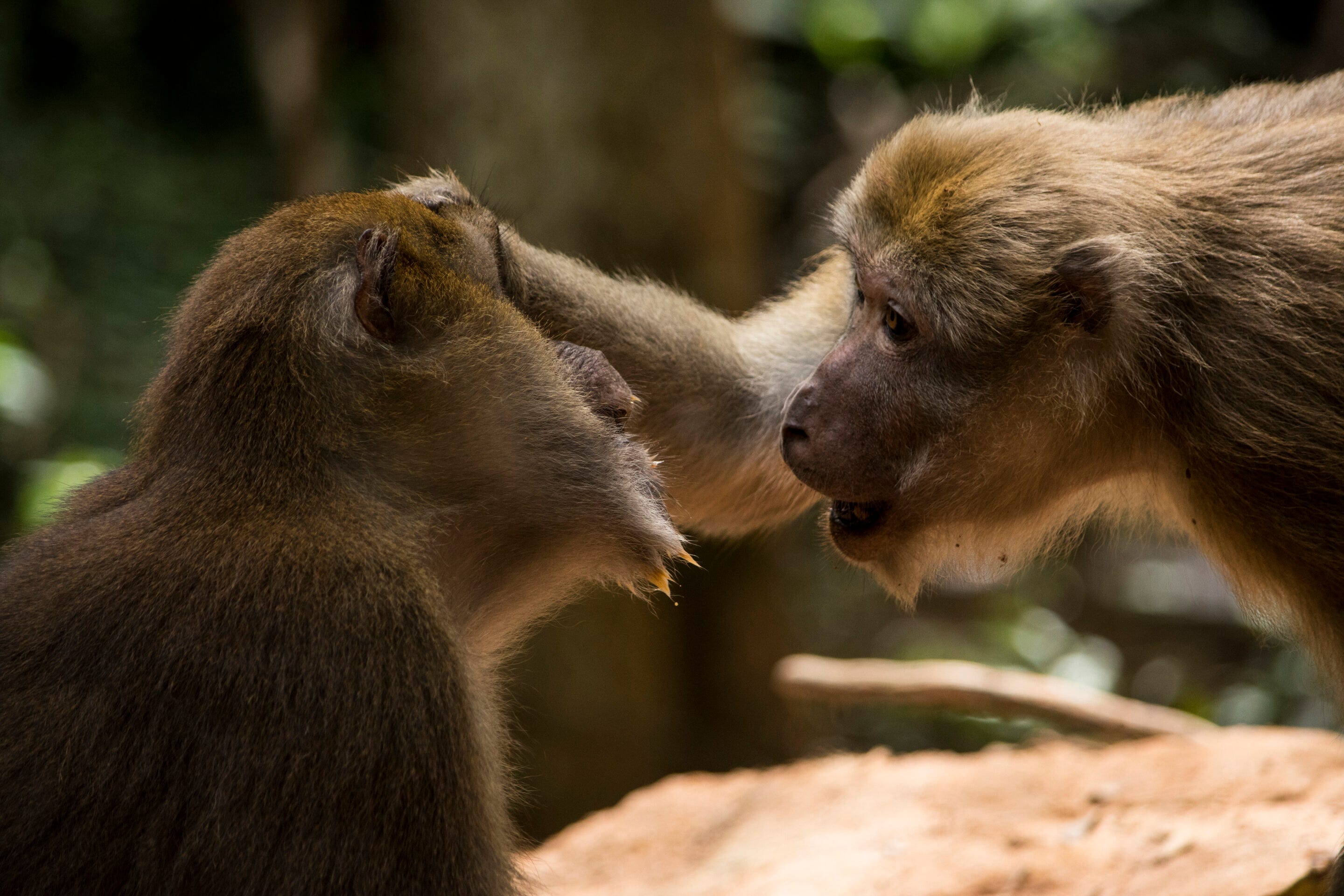
A common cause is the other worry: some general social skill that makes a male attentive and well-bonded and separately helps him rise. The authors argue that such a skill should tie bonds and rank together within each year, a pattern that was absent in the first year, moderate in the second and missing in the 2010 study, and they conclude only that more of the evidence points to a chain. That caution seems right to me, because with 46 males a weak within-year correlation is weak evidence either way, and a stable skill that helps a male make friends now and climb later by another route would leave the same staggered pattern.
Behind the attention scores there is also less data than 441 scenes suggests: about eight per male on average, roughly three of them friendly. Each score then entered the later models as a single number, with no allowance for its uncertainty, which tends to make the downstream intervals too narrow. Looking was judged from the eyes where observers could see them and from head direction alone where they couldn’t, and the paper gives no figure for how well its two observers agreed.
In several places the press release goes further than the paper. It says stronger bonds led to higher rank, where the paper says they predicted it, and it turns 19 percent more observed copulations per standard deviation of dominance into about 20 percent more matings for males significantly higher in the hierarchy. According to the release, males who watched friendly interactions longer also intervened more often, sometimes joining a friendly pair and sometimes breaking one up. The paper’s post hoc test of that idea, on 37 males with two to nine chances each to intervene, gave an estimate whose interval spans zero (−0.21 to 0.54), which the authors call tentative support. Joining and breaking up appear in the paper only as tactics seen in other species.
Julia Ostner, head of the Social Evolution in Primates research group at the German Primate Center (DPZ), goes further in the release, saying “our analyses suggest that curiosity made it easier for the macaques to form the right alliances so they could then climb the social hierarchy together.” The study timed looks rather than measuring curiosity, and it did not analyze coalitions, though earlier work here found that male bonds work as coalitions in contests over rank.
Does watching others pay off for macaques?
I’d call the paper partly convincing. The link between watching other males’ friendly interactions and having strong bonds is clear, and it rests on a measure of attention taken from free-ranging monkeys, which is the paper’s real contribution; earlier work tying cognition to fitness in wild animals mostly tested non-social skills such as learning and spatial memory. The step from bonds to later rank is the least certain link, but it matches what the same group found in this population before, and that replication raises my confidence in it. The study doesn’t show that watching comes first, or that friendly scenes matter more than conflicts.
Two tests would settle most of what remains. One needs no fieldwork: with the public replication data on GRO.data, anyone could refit the bond model to estimate the difference between the two attention effects directly. The other needs Phu Khieo. Males there move between groups, and a newcomer’s watching can be scored before his friendships in the new group take shape. If watching drives bonding, newcomers who spend longest watching other males’ friendly interactions in their first months should have the strongest bonds a year later.
Further Reading
Ostner, J., Vigilant, L., Bhagavatula, J., Franz, M., and Schülke, O. (2013). Stable heterosexual associations in a promiscuous primate. Animal Behaviour 86, 623–631. https://doi.org/10.1016/j.anbehav.2013.07.004
Kalbitz, J., Ostner, J., and Schülke, O. (2016). Strong, equitable and long-term social bonds in the dispersing sex in Assamese macaques. Animal Behaviour 113, 13–22. https://doi.org/10.1016/j.anbehav.2015.11.005
Pereira, S.M., Meesawat, S., Malaivijitnond, S., Schülke, O., and Ostner, J. (2026). Social monitoring predicts future rank and mating success in male macaques. Current Biology 36, 1–6. https://doi.org/10.1016/j.cub.2026.10.037
Schülke, O., Bhagavatula, J., Vigilant, L., and Ostner, J. (2010). Social bonds enhance reproductive success in male macaques. Current Biology 20, 2207–2210. https://doi.org/10.1016/j.cub.2010.10.058


