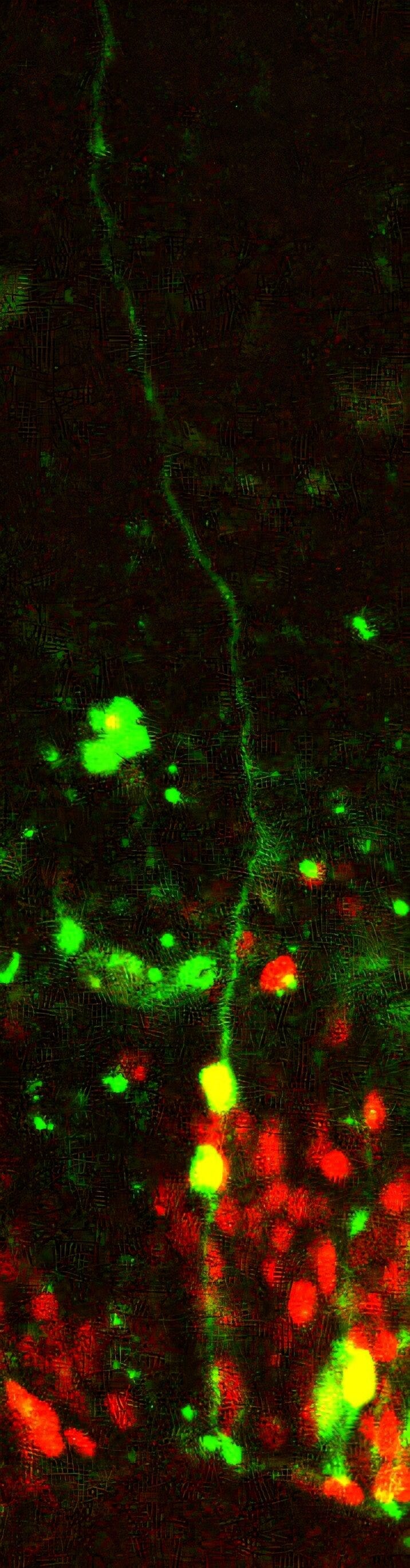
The most direct evidence in a new paper on primate brain evolution is a recording of one cell dividing. In a slice of embryonic mouse cortex, an apical radial glial cell splits, and one of the two daughters keeps a long process stretching toward the outer surface of the brain while the other does not. A day later that daughter divides again. The brain had been electroporated at embryonic day 13.5 with the human version of a gene called DACH1, and across 48 hours of two-photon recording, 28 of 192 traced daughter cells took that outer-progenitor fate. In control brains, 5 of 120 did. Those fractions, 14.58 percent against 4.17 percent, rest on 96 and 60 traced divisions, from three and two experiments.
Most people who follow this literature hold a specific belief about why the primate cortex looks the way it does, which is that primates acquired genes other mammals lack. ARHGAP11B, described by Marta Florio, Wieland Huttner and colleagues in 2015,1 increases basal progenitor numbers and cortical folding when introduced into mouse or ferret brain. DACH1 is not a gene of that kind. It has a counterpart in Drosophila called dac, mice carry a version called Dach1, and the protein does unrelated work in eye, ear, limb and kidney across vertebrates. Pei-Shan Hou at National Yang Ming Chiao Tung University, Hung-Chih Kuo at Academia Sinica and collaborators including Fumio Matsuzaki at Kyoto University are making a claim about regulation rather than about gene content.
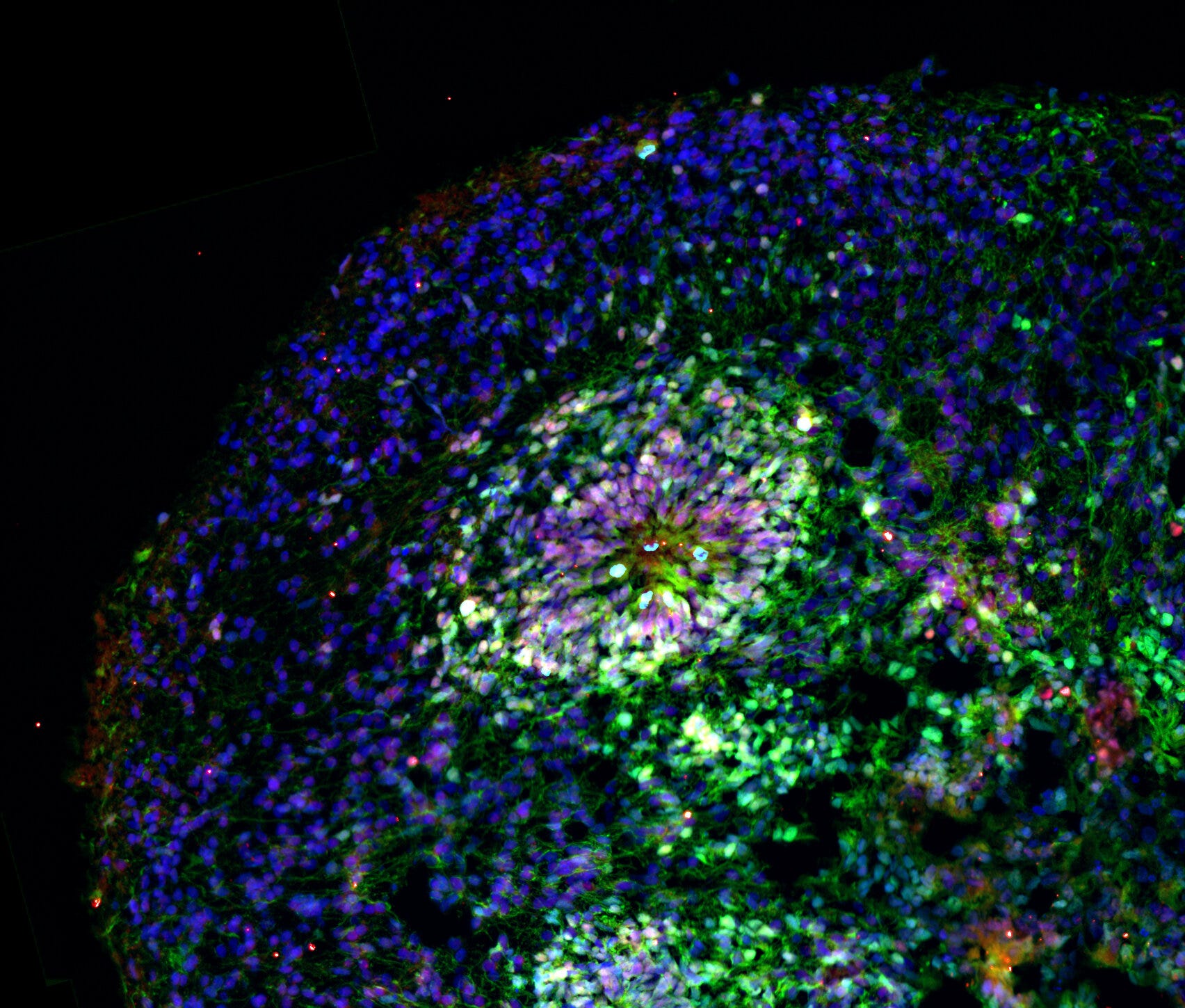
Writing in Science Advances,2 they report that a 310-base-pair stretch of non-coding DNA near DACH1, which they label Dc3-4, works as an enhancer, a short sequence that proteins bind in order to switch a nearby gene on. Dc3-4 carries a binding site for the transcription factor LHX2 that is complete in primate genomes and incomplete or absent in the other vertebrates the team aligned. Cutting those 310 bases out of human stem cells, and separately out of rhesus monkey stem cells, left the lab-grown cortical tissue derived from them short of cells carrying HOPX, a protein used to identify the progenitor type at the center of this story. Putting half a kilobase of the human sequence into a developing mouse brain had the opposite effect.