

The Tatacoa Desert in Colombia’s Huila Department looks nothing like a rainforest. It’s a badlands of rust-red and grey clay, scoured and cracked, more Mars than Amazonia. But below the surface, preserved in Miocene sediments, is the record of a vanished landscape that was once lush, swampy, and loud with animals. Thirteen million years ago, something like a proto-Amazon occupied this region. Giant ground sloths moved through it. Enormous armored relatives of modern armadillos foraged at its edges. And in the trees, a community of primates was diversifying at a rate unlike anything seen elsewhere in South America at the time.
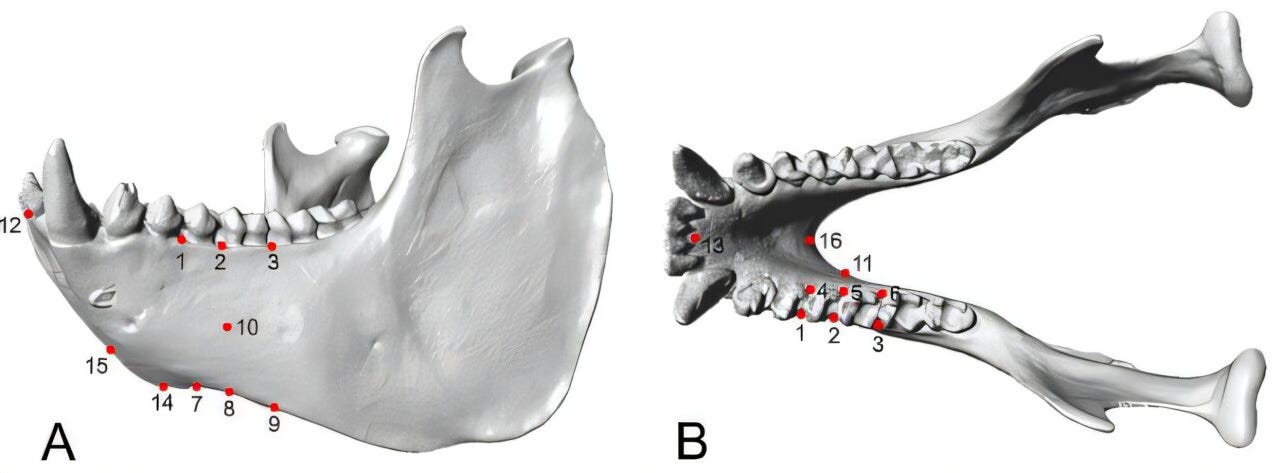
Two of those primates have now given up a little more of their story. Researchers led by Siobhán B. Cooke of Johns Hopkins University have described the first known lower jaws of Stirtonia victoriae, an ancient relative of modern howler monkeys. The specimens were recovered from La Repartidora, a fossil locality in the La Victoria Formation, by Andrés Vanegas of the Museo de Historia Natural La Tatacoa. They sat in sediments dated between 13.3 and 13.6 million years old. The study, published in PaleoAnthropology1 in 2026, uses three-dimensional geometric morphometrics to analyze both the shape of the teeth and the overall form of the mandible, and the results are clear: S. victoriae was eating a substantial quantity of leaves, making it the earliest confirmed folivore in the platyrrhine record.
That’s a specific, bounded claim. But the implications spread outward in ways that matter for understanding how primate diversity in the New World actually developed.


