

The Biological Research Station fragment in Mexico’s Los Tuxtlas Biosphere Reserve covers 199 hectares. That makes it the largest of the 10 forest fragments in a new study of the howler monkey gut microbiome. The authors put it at the far end of their habitat gradient from Agaltepec, the most isolated site and the one with the fewest tree species. The team collected feces from adult male mantled howlers in October and November 2022. Several males there and at Cerro del Borrego, an 85-hectare fragment, had markedly higher levels of glucocorticoids than males elsewhere. Glucocorticoids are hormones usually read as a stress signal, and the team had predicted the opposite result.
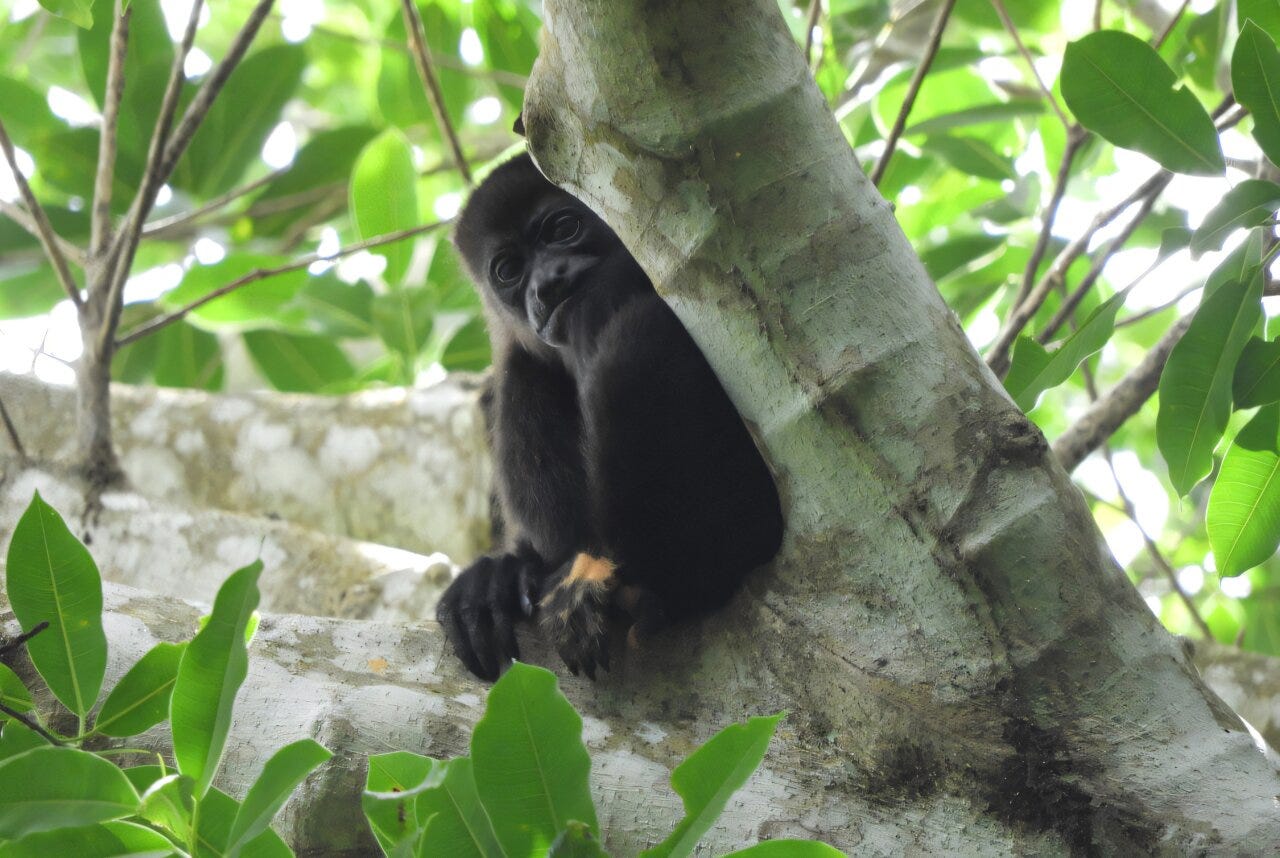
Glucocorticoids such as cortisol are measured in wild primates through their breakdown products in feces. The authors note that these hormones also rise with energy demands and social competition. The study tested an expectation that I think most readers share: that habitat loss shows up in a primate’s body as a uniformly worse profile. On that view, the smaller and more degraded the fragment, the more stressed the monkey and the poorer its gut microbiome. Mantled howlers suit that test because they are notable among primates for persisting in small, isolated forest fragments.
The paper, in Animal Conservation,1 is by Tabor L. Whitney and Katherine R. Amato of Northwestern University with colleagues at two Mexican institutions. They studied the endangered subspecies Alouatta palliata mexicana and measured three things in its feces. The first was the gut microbiome (the gut’s bacterial community). The second was the short-chain fatty acids those bacteria make by fermenting plant fiber, and the third was glucocorticoid levels. The microbiome differed most clearly among fragments and was linked to the most habitat features. These included fragment area, tree size, and the number of tree lines, which the authors use to measure canopy connectivity. The other two measures did not differ significantly among fragments, though two vegetation features predicted glucocorticoid levels. Whitney, now a postdoctoral scholar in the Trienens Institute Climate Change Research Group at Northwestern, said in the press release: “An awesome takeaway of the study is the knowledge that the gut microbiome is the most sensitive to ecological change.” I think that holds for microbiome composition, meaning which bacteria are present and in what proportions, because it separated the fragments more cleanly than any other measure. Whether composition is also a good guide to the animals’ health is another matter.


